
RTD Sensor Spares: Match the Wiring Circuit
Keep RTD sensor identity, lead arrangement and the receiving measurement circuit together before approving a replacement or alternate.
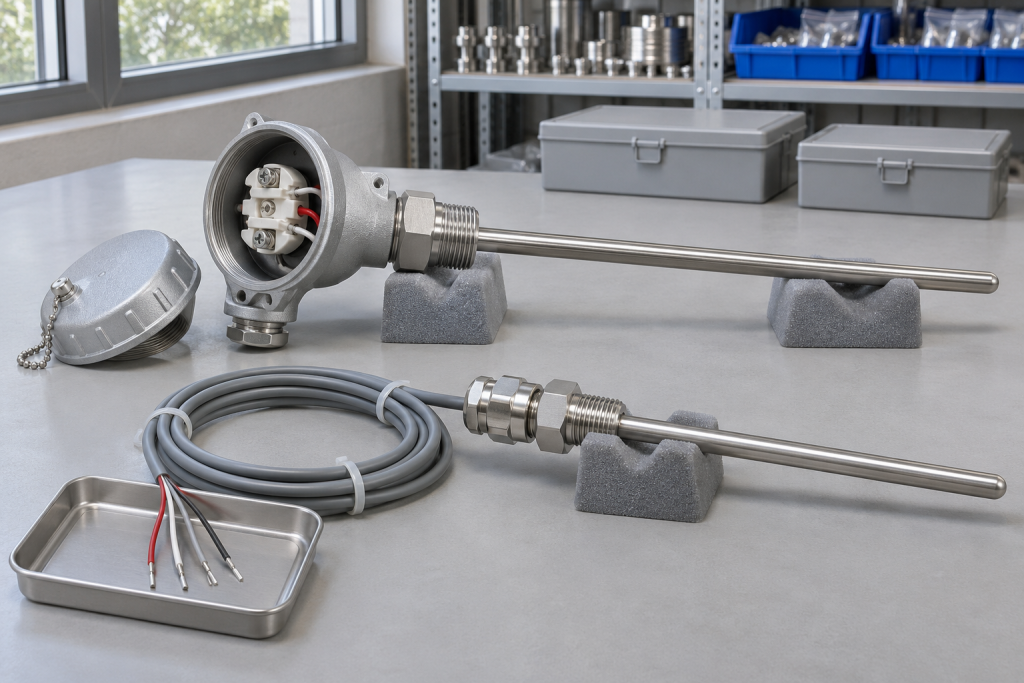
An RTD spare request can look precise while leaving the measurement circuit undefined. The probe diameter, thread and temperature range are listed, but the offer simply says Pt100. During replacement, the team discovers that the lead arrangement does not match the approved input configuration. The purchasing gap was not the sensor family; it was the missing connection requirement.
For RTD sensor spares, keep the sensing element, lead arrangement and receiving instrument together. This is a procurement and acceptance guide, not permission to reconnect a live temperature loop or change a controller channel. Process isolation, hazardous-area requirements and any protective function remain under the site’s approved engineering procedures.
Identify the element before counting wires
WIKA’s temperature measurement FAQ distinguishes Pt100 from Pt1000 by nominal resistance at zero degrees Celsius: 100 and 1,000 ohms respectively. Those designations identify an important characteristic, but they do not describe a complete replacement. Record the exact manufacturer code, element characteristic specified by the original documentation, accuracy requirement and permitted operating conditions.
Keep a photograph of the nameplate and the associated instrument record. Do not infer the complete element specification from the shape of the probe or a purchasing shorthand. A proposal with missing information should remain a clarification request, rather than becoming an approved alternate through repetition in quotations.
Ask what the receiving circuit expects
Minco’s RTD connection explanation shows why the wiring arrangement matters. In an uncompensated two-wire measurement, connecting lead resistance contributes to the measured resistance. Its three-wire bridge example relies on closely matched lead resistances, while the four-wire arrangement separates measuring-current and voltage-sensing paths.
The procurement implication is not that every installation needs four wires. It is that the spare must suit the documented measurement circuit and required performance. Obtain the installed input module or transmitter identity, channel configuration and manufacturer connection diagram. Record whether the replacement is a bare resistance sensor or an assembly containing a transmitter; they are different purchasing boundaries.
Do not count the external conductors of a complete assembly and assume they directly reveal the internal sensing arrangement. Ask for the diagram that relates the offered terminals to the specified element. Keep uncertainty visible until the responsible engineer has reviewed it.
Treat adaptation as a separate engineering decision
A different lead count should trigger review, not an improvised terminal bridge. Fluke’s three-wire RTD measurement note describes arrangements for particular data-acquisition instruments and explains that extension wiring changes the method and remaining error. That is evidence of instrument-specific conditions, not a universal conversion recipe.
Ask who owns any proposed adaptation, which exact instructions apply and what acceptance evidence is required. Keep the original requirement and the proposed deviation in separate fields. A supplier’s statement that a probe can be connected does not establish that the installed measurement chain will retain its intended performance.
This guide deliberately provides no jumper positions, compensation values or live measurement steps. Those depend on the actual instrument, circuit and approved work scope. A generic procurement article cannot authorize a change to a control or protective function.
Include the installed cable and mechanical boundary
Retain the available lead and extension-cable details, junction arrangement and termination drawings with the request. Ask the engineer to identify unresolved differences that could affect the approved measurement. Do not silently exclude installed wiring from the review simply because the purchasing line covers only the probe.
Mechanical fit still matters: specify the approved dimensions, connection, insertion arrangement and any associated assembly that must remain unchanged. The industrial sensor model-matching checklist provides the broader identity framework. This RTD review adds the resistance-measurement circuit; it does not replace those mechanical or application checks.
Write an acceptance record that another shift can use
Separate documentary acceptance from physical inspection and any authorized functional work. The record should name the offered unit, supporting manufacturer documents, approved circuit, reviewer and outstanding checks. If a test report is supplied, ask what sensor and instrument arrangement it actually covered. A result without that context cannot close the installed-application question.
Use the industrial sensor category to organize the sourcing enquiry when the installed code has not yet been established. A similarly described temperature input module is not a replacement probe. Do not nominate a specific product until its role and complete variant match the documented requirement.
Keep unresolved items on hold with an owner and next action. A received probe should not be counted as ready coverage merely because it is present in the stores location. The release record must make clear whether the remaining work concerns identity, circuit compatibility, documentation or application acceptance.
FAQ
Does Pt100 specify a complete replacement sensor?
No. It identifies a nominal resistance characteristic. Confirm the complete element specification, lead arrangement, mechanical requirements and receiving instrument before approving the spare.
Is a four-wire probe automatically a drop-in upgrade?
No. The receiving circuit, permitted connection and application acceptance still require review. More conductors alone do not establish installation compatibility.
Can a generic drawing authorize a lead-count conversion?
No. Use instructions for the exact sensor and receiving instrument. Any deviation needs a responsible engineering decision and an approved acceptance scope.
What should accompany an RTD spare quotation request?
Provide complete codes, nameplate photographs, element and lead requirements, input instrument details, drawings, quantity and deadline. Identify missing evidence explicitly rather than asking the supplier to guess.
Prepare the spare review
Send model numbers, nameplate photographs, discontinued replacement requirements and required delivery dates to [email protected] or WhatsApp/Phone +86 18259474341. State whether the enquiry covers a probe only or also needs a documented review of the receiving measurement circuit.
Route this topic into a sourcing request
Connect the article topic to a model number, category, brand, quantity, and destination before opening the RFQ.
Related Insights
Continue with sourcing and model matching guides
 Nov 28, 2026
Series 90-30 Spares: Check the RX3i Rack Boundary
Separate exact Series 90-30 spares from the verified RX3i rack, processor and retained I/O needed for a planned migration.
Read guide Nov 27, 2026
HMI Screen Spares: Identify the Failed Layer
Separate surface damage, touch input and the supported display assembly before specifying an HMI hardware spare.
Read guide Nov 26, 2026
Motor Brake Rectifier Spares: Match the Coil
Check the fitted brake coil and approved control function before treating a motor brake rectifier as an exact spare.
Read guide