
Schneider RTU Advisory: Spare and Firmware Checks
How the Schneider EasyLogic T150 and Saitel DP RTU advisory affects spare RTU planning, firmware checks, and remote-site maintenance.
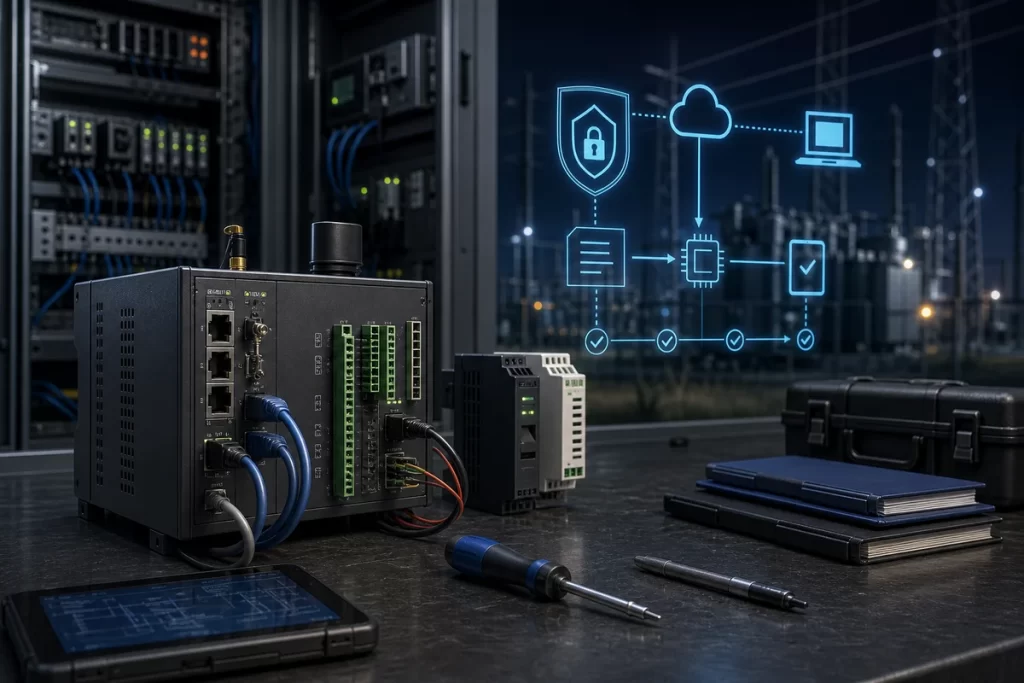
CISA’s June 30, 2026 advisory for Schneider Electric EasyLogic T150 and Saitel DP RTU is a useful reminder that remote terminal units should not be treated as simple black boxes in a spare-parts program. The advisory covers credential protection and permission issues in specific firmware versions, with a CVSS v3 score of 7.5. CISA states that successful exploitation could allow unauthorized access and exposure of sensitive information when an unauthenticated attacker accesses credentials stored within firmware or system files.
The affected versions are EasyLogic T150 firmware up to 11.06.30 for CVE-2026-9650 and up to 11.06.31 for CVE-2026-9651, plus Saitel DP firmware up to 11.06.35 for CVE-2026-9650 and up to 11.06.37 for CVE-2026-9651. CISA also notes that no known public exploitation specifically targeting these vulnerabilities had been reported at publication time. That keeps the response practical: verify firmware, control access, plan the update window, and make sure any spare RTU does not arrive as an undocumented risk.
Why RTU advisories matter to spare planning
RTUs often sit in places where maintenance is harder than in a plant cabinet: substations, water sites, oil and gas skids, utility yards, pump stations, or remote process units. A spare may need to restore telemetry, digital I/O, analog measurements, event records, or communication with SCADA. If that spare has the wrong firmware, incomplete configuration notes, or unclear credential handling, the replacement can become a second outage.
For teams sourcing Schneider Electric automation parts, the request should go beyond the product family name. Capture the exact installed model, firmware version, role in the site architecture, communication paths, power supply arrangement, I/O cards, and whether the device is exposed through remote access. The part number matters, but the operational context is what makes the spare usable.
Firmware fixes need a maintenance window
The advisory states that EasyLogic T150 version 11.06.32 includes a fix for CVE-2026-9650, and Saitel DP version 11.06.38 includes a fix for CVE-2026-9650. The listed vendor fixes require reboot. That is a small line in an advisory, but it is a major planning point for remote sites. A reboot can interrupt telemetry, control commands, local event capture, or communication with upstream SCADA. It may also require coordination with operations, dispatch, site access, and rollback preparation.
When evaluating industrial PLC and controller sourcing, include firmware evidence in the same package as the hardware request. If the installed RTU cannot be updated immediately, record why: operational window unavailable, firmware access pending, configuration backup missing, remote site access restricted, or compatibility not yet validated. Those reasons affect whether the right purchase is an exact spare, a staged spare, or a planned replacement path.
Physical access still matters
The CISA summary describes scenarios involving credentials stored within firmware or system files, and the CVE detail notes subsequent compromise risk if an attacker has physical access to the device. That detail is important. Many remote automation assets are exposed to a different threat model than locked factory panels. Field cabinets may be shared with utilities, contractors, telecom equipment, or environmental monitoring systems. A device can be “not internet-facing” and still be physically vulnerable.
For RTU spare strategy, physical access evidence should be collected along with network evidence. Photograph the cabinet, label the installed modules, record whether removable media is used, identify local maintenance ports, and confirm whether any engineering laptop or local HMI is normally connected. If the RTU exchanges data through gateways or serial/Ethernet interfaces, related communication modules and I/O hardware should be reviewed at the same time.
Do not let firmware become a blind spot
Many plants and utilities know exactly how many RTUs are installed, but not exactly which firmware version each site runs. That gap becomes visible only when an advisory, a failure, or a migration project forces a review. A good spare file should include model, firmware, configuration backup status, I/O map, communication settings, power supply details, remote access method, and site criticality. This is not paperwork for its own sake; it is the difference between a controlled swap and a field escalation.
A structured replacement risk review for automation parts is useful when firmware, credentials, site access, and physical replacement are connected. The same hardware may be a low-risk spare in a lab and a high-risk spare in a remote energy site. The review should make that difference visible before a purchase order is issued.
FAQ
Does this advisory mean every EasyLogic T150 or Saitel DP RTU must be replaced?
No. The advisory should trigger firmware and exposure review first. Some sites may only need a planned update and access-control check. Others may need a staged spare or replacement path if firmware cannot be updated safely within the required operating window.
What firmware versions should maintenance teams check?
Check whether EasyLogic T150 devices are at or below 11.06.30 or 11.06.31 depending on the CVE, and whether Saitel DP devices are at or below 11.06.35 or 11.06.37. The advisory identifies fixed versions including EasyLogic T150 11.06.32 and Saitel DP 11.06.38 for CVE-2026-9650.
What should I include in an RTU spare request?
Include the exact model, firmware version, label photos, installed modules, I/O count, communication ports, power supply details, configuration backup status, site criticality, destination, quantity, and whether firmware update or configuration loading is required before commissioning.
Can a firmware update be handled like a normal software patch?
Not in most RTU environments. A firmware update may require reboot, communication testing, site access, rollback planning, and operations approval. It should be treated as a maintenance activity, not a casual background update.
How should remote-site access be handled during the review?
Confirm whether the RTU is reachable from business networks, VPNs, cellular routers, engineering laptops, or local service ports. Limit access to trusted paths, document who can connect, and avoid leaving temporary access open after troubleshooting.
Practical next step
If your plant or utility is reviewing EasyLogic T150, Saitel DP, or similar RTU spares after this advisory, prepare model evidence, firmware version, module photos, communication paths, configuration backup status, site criticality, required quantity, and maintenance-window constraints before sourcing. SmartNexMSK can help route the request as exact spare sourcing, firmware evidence review, or lifecycle replacement planning. Send details to [email protected] or WhatsApp/Phone +86 18259474341.
Source checked: CISA ICS Advisory ICSA-26-181-04, Schneider Electric EasyLogic T150 and Saitel DP RTU, June 30, 2026.
Route this topic into a sourcing request
Connect the article topic to a model number, category, brand, quantity, and destination before opening the RFQ.
Related Insights
Continue with sourcing and model matching guides
 Sep 8, 2026
SANYO DENKI QS1E Spares: Save Parameters First
When a SANMOTION Q axis stops, the purchasing request often becomes a model number: “Please quote QS1E01AA0H4A3P1T.” That is a useful starting point, but…
Read guide Sep 6, 2026
Yaskawa SGDH-05DE-OY Spares: Check the Servo Chain
A servo drive fault often produces a deceptively simple purchasing request: “Replace the SGDH-05DE-OY.” In a running machine, however, the amplifier is only one…
Read guide Sep 5, 2026
GE IS220PCLAH1A Spares: Check Mark VIe Fit
When a Mark VIe cabinet develops an intermittent control fault, the urgent request often becomes a single line: “Please quote IS220PCLAH1A.” That is understandable…
Read guide