
StoneFly Storage Advisory: OT Backup Recovery Risk
How the StoneFly Storage Concentrator advisory affects OT backup storage, engineering archives, recovery planning, and maintenance RFQs.
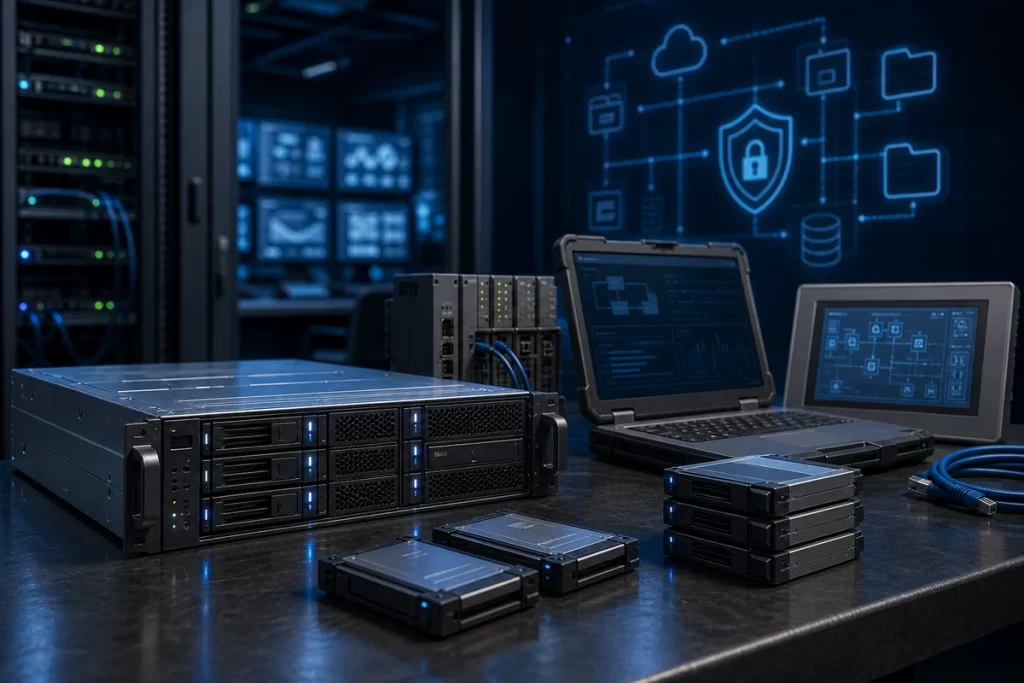
CISA’s June 30, 2026 advisory for StoneFly Storage Concentrator is not a PLC module notice, but it has direct relevance for plants that depend on engineering archives, virtual machines, historian backups, HMI project files, and recovery images. The advisory covers StoneFly Storage Concentrator and Storage Concentrator Virtual Machine versions below several fixed levels, including versions below 8.0.4.22, 8.0.4.26, and 8.0.4.29 depending on the CVE. CISA lists the vendor equipment vulnerability score as CVSS v3 10.
The issue set is severe: hard-coded credentials, command injection, SQL injection, and cross-site scripting. CISA states that successful exploitation could allow broad unauthorized access, arbitrary command execution with root privileges, sensitive data theft, and actions on behalf of legitimate users across interconnected systems. StoneFly recommends upgrading to Storage Concentrator version 8.0.4.29 or later. No known public exploitation specifically targeting these vulnerabilities had been reported to CISA at publication time.
Why backup storage belongs in an OT spare review
Many factories still think of storage as an IT topic. In practice, OT recovery often depends on storage infrastructure: PLC project backups, HMI screen projects, SCADA virtual machines, historian databases, drive parameter archives, engineering laptop images, and vendor software installers. If the system holding those files is compromised, unavailable, or poorly documented, a physical spare part may not be enough to restore production.
When teams review communication modules and I/O hardware, they often collect wiring photos and model numbers but forget the recovery files that make those components useful. A replacement gateway, controller, or I/O rack may require address tables, firmware files, exported configuration, or a project backup. Storage risk therefore becomes maintenance risk.
The recovery chain is only as strong as its archive
A good spare-parts program answers two questions. First: can we obtain the hardware? Second: can we return the asset to its exact working role? Storage infrastructure supports the second question. If backups are stored on a vulnerable or unmanaged system, the plant may discover during a breakdown that it has the right spare and the wrong project file, or that the backup exists but cannot be trusted.
For industrial PLC controller sourcing, include project backup location and verification status in the RFQ evidence. Do not just attach a part number and quantity. Record whether the backup is current, who last verified it, where it is stored, whether it is offline or online, and whether a clean copy exists outside the potentially affected storage environment.
What maintenance teams should check
Start with an inventory of storage systems that support OT recovery. Identify systems holding PLC projects, HMI backups, SCADA VM snapshots, historian data, maintenance manuals, firmware packages, and engineering workstation images. Then check product version, network exposure, administrative access, backup replication paths, and whether the system can be isolated during incident response without losing access to critical recovery files.
If the storage platform holds HMI or SCADA projects, connect the review to HMI and touch panel replacement planning. A spare panel is not ready if the project file is stale, unverified, or stored only on a vulnerable online repository. The same applies to older SCADA workstations where the project exists only inside a virtual machine image.
Do not let cybersecurity break recovery
Security teams may want to isolate or update affected storage quickly. Operations teams may worry that doing so will remove access to recovery files. Both concerns are valid. The right response is not to leave the system exposed, and it is not to shut down the only recovery repository without a plan. Before applying updates or isolating systems, confirm that critical project files are copied to a controlled, offline, verified location.
A structured replacement risk review for automation parts should include backup evidence when the spare depends on software or configuration. That review makes a practical distinction: a boxed spare is stock; a boxed spare plus a verified project backup is recovery readiness.
FAQ
Does this advisory affect PLC hardware directly?
No. The advisory concerns StoneFly Storage Concentrator and Storage Concentrator Virtual Machine. The relevance to PLC maintenance is indirect but important: storage systems may hold the backups and images required to commission PLC, HMI, SCADA, and gateway spares.
Which versions should be reviewed?
CISA lists affected Storage Concentrator and Storage Concentrator Virtual Machine versions below 8.0.4.22, below 8.0.4.26, and below 8.0.4.29 depending on the specific vulnerability. The vendor recommendation is to upgrade to 8.0.4.29 or later.
What should be copied before isolating or updating storage?
Copy verified PLC projects, HMI projects, SCADA VM images, historian recovery data, firmware packages, drive parameters, network device configs, license files, and maintenance manuals needed for emergency recovery. Keep the copy controlled and offline where possible.
How does this change a spare-parts RFQ?
For any spare that needs configuration, include backup status in the request: where the project file is stored, whether it is current, whether the supplier needs a clean copy, and whether commissioning support is required.
Should backup storage be part of the critical spares list?
For many plants, yes. It may not sit inside the control panel, but it can determine whether a replacement part restores production quickly or becomes a long recovery exercise.
Practical next step
If your plant is reviewing OT backup storage, SCADA VM recovery, or spare commissioning files after this advisory, prepare the storage platform version, network exposure notes, critical backup list, project verification status, affected production areas, and recovery time limits before sourcing or isolating systems. SmartNexMSK can help route the request as spare sourcing, backup evidence review, or lifecycle recovery planning. Send details to [email protected] or WhatsApp/Phone +86 18259474341.
Source checked: CISA ICS Advisory ICSA-26-181-06, StoneFly Storage Concentrator, June 30, 2026.
Route this topic into a sourcing request
Connect the article topic to a model number, category, brand, quantity, and destination before opening the RFQ.
Related Insights
Continue with sourcing and model matching guides
 Sep 8, 2026
SANYO DENKI QS1E Spares: Save Parameters First
When a SANMOTION Q axis stops, the purchasing request often becomes a model number: “Please quote QS1E01AA0H4A3P1T.” That is a useful starting point, but…
Read guide Sep 6, 2026
Yaskawa SGDH-05DE-OY Spares: Check the Servo Chain
A servo drive fault often produces a deceptively simple purchasing request: “Replace the SGDH-05DE-OY.” In a running machine, however, the amplifier is only one…
Read guide Sep 5, 2026
GE IS220PCLAH1A Spares: Check Mark VIe Fit
When a Mark VIe cabinet develops an intermittent control fault, the urgent request often becomes a single line: “Please quote IS220PCLAH1A.” That is understandable…
Read guide