
Terminal Block Spares: Keep the Conductor Record
Keep terminal function, complete identity and the documented conductor arrangement together before accepting a spare.
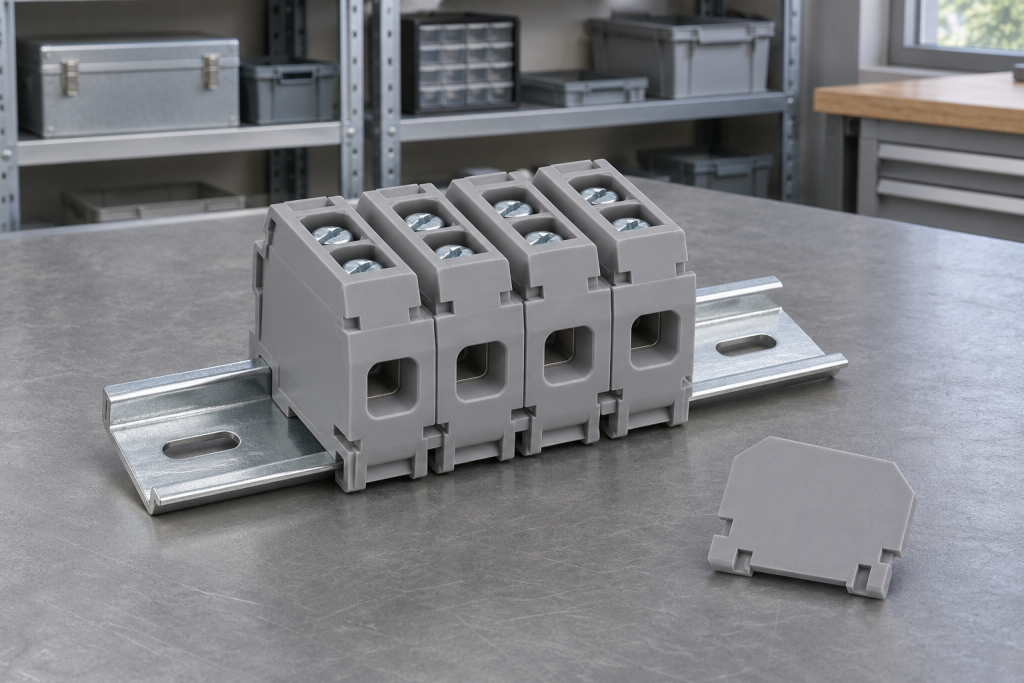
A terminal block spare can look correct on a stores shelf while leaving the actual conductor requirement unanswered. The offer names a nominal size and a familiar connection technology, but the installed record does not say whether the conductor is rigid, flexible or fitted with a particular ferrule. A matching outline cannot resolve that missing information.
For terminal block spares, keep the complete component identity beside the documented conductor arrangement. This is a purchasing and documentary acceptance review, not a wiring, stripping, crimping or live-testing procedure. Installation, electrical isolation and application approval remain with qualified personnel under the equipment owner’s authorised arrangements.
Identify the terminal function before the wire range
Record the complete installed reference and its circuit function from controlled documentation. State whether the request concerns a feed-through terminal, a disconnect or test function, a protective-conductor arrangement, a fused component or a proprietary I/O assembly. These descriptions are not interchangeable merely because each item is called a terminal block.
WAGO’s rail-mount terminal block overview separates several terminal functions, mounting forms and connection technologies. The procurement implication is to preserve the identified function and assembly boundary before comparing the size printed in a supplier’s headline.
Keep the terminal location, drawing reference, level arrangement and required accessories in the enquiry. If the original reference is incomplete, identify the missing evidence rather than treating a similar photograph as a confirmed replacement. Do not substitute a general-purpose terminal for a specialised circuit function without its responsible owner’s review.
Keep nominal size separate from connection data
A nominal cross-section is not a complete description of every conductor configuration a terminal accepts. Ask for the applicable manufacturer’s connection-data table for the exact offered code, including the conductor categories and any conditions attached to them. Do not reduce that table to its largest number.
Phoenix Contact’s UK 5 N technical data provides a useful example: it lists rigid and flexible conductors separately, then distinguishes ferrules with and without plastic sleeves and certain multiple-conductor arrangements. Those are categories of evidence, not numerical recommendations for an unidentified installation.
Preserve the stated units and the applicable document revision. Do not convert an AWG description into an assumed universal match or transfer one variant’s permitted range to another. This guide gives no conductor-size calculation, current selection rule or permission to change the installed wiring.
Make conductor preparation part of the record
Ask the engineering owner which conductor construction and termination preparation belong to the approved installation. Keep the answer alongside the conductor cross-section and terminal reference. A purchasing description that says only flexible wire can omit a distinction that appears explicitly in the manufacturer’s data.
WAGO’s ferrule guidance for splicing connectors explains why blanket ferrule approval is not possible in that scope. It discusses the effect of the ferrule and its collar on accommodation. It is not a universal approval table for all DIN-rail terminals or permission to transfer splicing-connector instructions to another product.
For an actual terminal block replacement, obtain the exact product’s permitted combination and the application owner’s acceptance. Keep any existing preparation method documented; do not prescribe a new ferrule, crimp profile or strip length from a generic article. Procurement can expose an unresolved question without instructing work on a circuit.
Do not infer multiple-conductor acceptance
The number of visible openings does not establish how many conductors may share one clamping point. Record the approved number and arrangement from the circuit documentation, then request the relevant manufacturer’s explicit connection data. Separate different terminal levels and potentials in that record.
The Phoenix Contact example distinguishes particular two-conductor configurations from single-conductor entries. That distinction is the reason to retain the full table and its conditions. It is not approval to add a conductor, use a twin ferrule or share a connection point on an unrelated terminal.
Identify any associated bridge, partition, end plate or marking requirement where applicable. A proposed accessory belongs with its exact family and function; colour or apparent mechanical fit alone does not establish that it preserves the approved circuit arrangement.
Keep the supplied assembly and open questions visible
The product-label photograph guide supports the wider identity record. Add the controlled drawing reference and available conductor information to a terminal enquiry. Obtain photographs only through the site’s permitted process; do not disturb connections or remove equipment to complete a quotation.
The published terminal block category is a sourcing route containing different component and assembly types, not a conductor-compatibility table. No individual listing is endorsed here for an unidentified circuit. A proprietary I/O terminal assembly is not automatically equivalent to a general rail terminal.
Request the complete offered code, included accessories and supporting manufacturer references. Separate commercial identity, receiving inspection and any authorised application verification. An electrical test report establishes only the component, conditions and checks actually covered; it does not supply missing conductor or circuit approval.
Keep unresolved differences on hold with an owner and next action. The acceptance record should make clear what was requested, what was offered and which questions remain. An item in stores is not qualified spare coverage simply because it fits an available rail.
FAQ
Does the nominal terminal size qualify a spare?
No. Retain the exact function, complete code, conductor configuration and applicable connection-data conditions.
Can a ferrule be assumed acceptable for every terminal?
No. Use the exact product’s permitted combination and the equipment owner’s approved preparation record.
Do two visible openings permit two wires in one clamp?
No. Opening count does not replace explicit manufacturer data for the approved conductor arrangement.
Does a matching rail prove a compatible replacement?
No. Mechanical mounting does not establish circuit function, conductor acceptance or application release.
Prepare the terminal block enquiry
Send complete models, nameplate photos, available conductor records, discontinued-part replacement needs and delivery requirements to [email protected] or WhatsApp/Phone +86 18259474341. Identify missing information without disturbing operating equipment.
Route this topic into a sourcing request
Connect the article topic to a model number, category, brand, quantity, and destination before opening the RFQ.
Related Insights
Continue with sourcing and model matching guides
 Nov 28, 2026
Series 90-30 Spares: Check the RX3i Rack Boundary
Separate exact Series 90-30 spares from the verified RX3i rack, processor and retained I/O needed for a planned migration.
Read guide Nov 27, 2026
HMI Screen Spares: Identify the Failed Layer
Separate surface damage, touch input and the supported display assembly before specifying an HMI hardware spare.
Read guide Nov 26, 2026
Motor Brake Rectifier Spares: Match the Coil
Check the fitted brake coil and approved control function before treating a motor brake rectifier as an exact spare.
Read guide