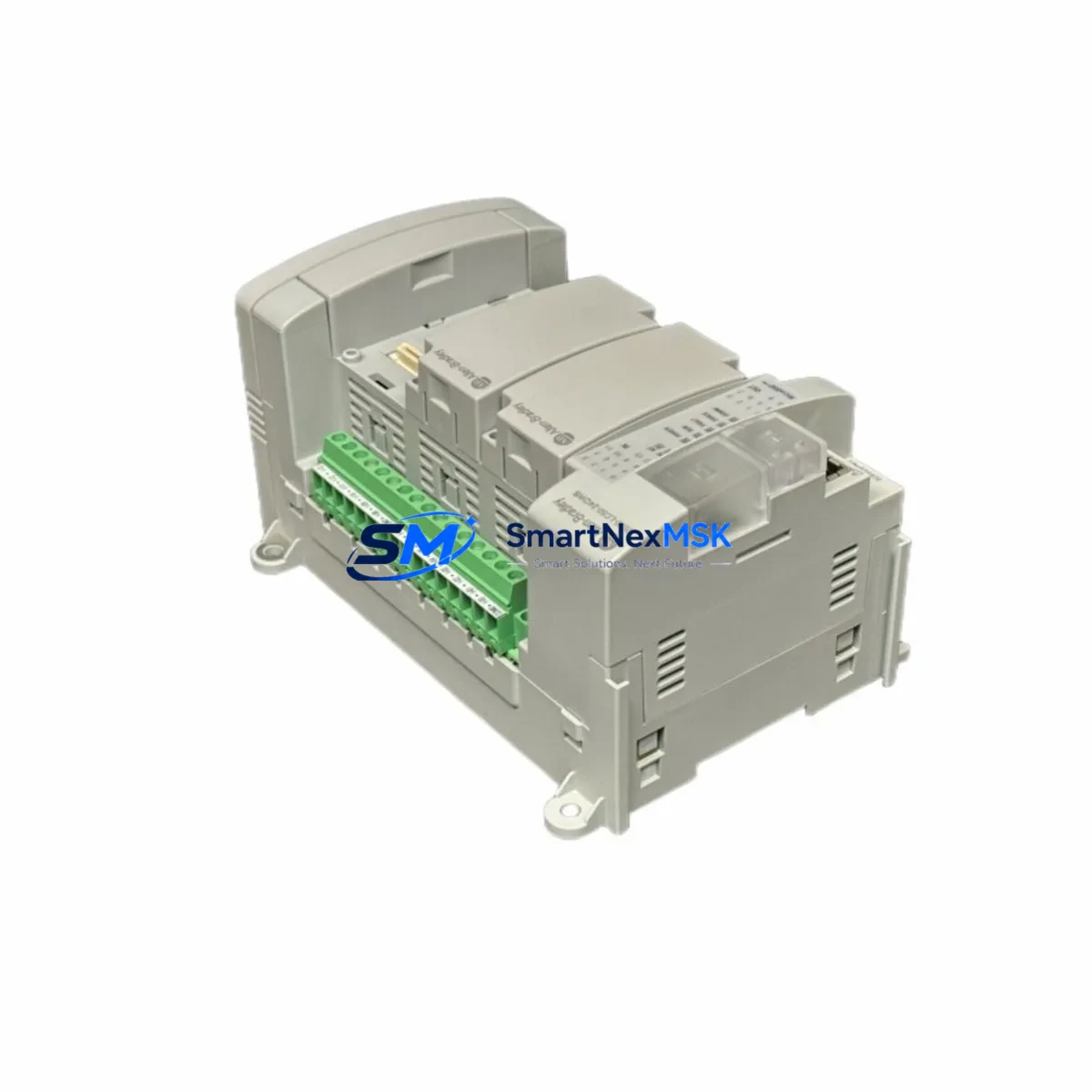
Allen-Bradley 2080-LC50-24QWB Retrofit-Ready PLC Controller for Micro850 Control Systems
The Allen-Bradley 2080-LC50-24QWB is a 24-point compact programmable logic controller from the Micro850 series, purpose-built for industrial environments where legacy system modernization, discontinued-part replacement, and control cabinet upgrades are the primary engineering challenge. Whether you are retiring an aging Micro830 controller, migrating from a third-party compact PLC platform, or expanding I/O capacity on an existing Micro800 rack, the 2080-LC50-24QWB delivers a proven, field-validated upgrade path with minimal disruption to your production line.
This controller features 14 DC inputs and 10 transistor outputs (QWB = 24 VDC sourcing), an onboard EtherNet/IP port for seamless integration with existing plant-floor networks, and two plug-in module slots that accept the full range of 2080-series plug-in expansion cards. The CPU is fully compatible with Connected Components Workbench (CCW) programming software, allowing engineers to reuse, adapt, or migrate ladder logic, function block diagrams, and structured text programs from earlier Micro800 controllers without rewriting from scratch.
For facilities running older Micro830 (2080-LC30) or early Micro850 variants, the 2080-LC50-24QWB is the recommended direct replacement. Before installation, engineers should verify the existing 24 VDC power supply capacity — the Micro850 draws slightly more current than the Micro830 under full I/O load, and the onboard power supply of the 2080-PS120-240VAC or equivalent DIN-rail power supply must be rated accordingly. Terminal wiring is largely compatible, but the field wiring diagram should be cross-checked against the new controller’s I/O map to confirm input sink/source polarity and output transistor type alignment.
Upgrade Compatibility Table
| Parameter | Legacy Model (Micro830 / Early Micro850) | 2080-LC50-24QWB (This Unit) | Retrofit Notes |
|---|---|---|---|
| I/O Count | 24 points (typical) | 24 points (14 DI / 10 DO) | Direct I/O count match; verify terminal assignments |
| Output Type | Relay or Transistor (model-dependent) | Transistor, 24 VDC Sourcing (QWB) | Confirm load compatibility; relay loads may need interposing relays |
| Communication | USB only (Micro830) / EtherNet/IP (Micro850) | EtherNet/IP + USB | Full EtherNet/IP upgrade for Micro830 sites; no protocol migration needed for Micro850 |
| Plug-in Slots | 0–2 (model-dependent) | 2 plug-in slots | Existing 2080-series plug-in modules (serial, analog, thermocouple) are reusable |
| Programming Software | CCW (Connected Components Workbench) | CCW (same platform) | Program import supported; verify firmware version compatibility |
| Backplane / Rack | Standalone (no expansion rack) | Standalone + 2080-series plug-ins | No rack change required; plug-in modules mount directly |
| Power Supply | 24 VDC external | 24 VDC external | Verify supply current rating; Micro850 may draw up to 800 mA at full load |
| HMI Compatibility | PanelView Component / 800 series | PanelView Component / 800 series | EtherNet/IP HMI connection retained; update IP address in HMI project |
| Warranty | N/A (legacy / discontinued) | 12 Months | Covered from date of shipment; includes functional and communication testing |
Retrofit Planning for Existing Automation Systems
A successful retrofit begins well before the controller is physically swapped. The first step is a full audit of the existing control cabinet: document every terminal block connection, label each wire against the original I/O list, and photograph the wiring before any disassembly. For sites using a 2080-LC30-24QBB (Micro830 relay output variant), the transition to the 2080-LC50-24QWB transistor output model requires careful load analysis — inductive loads such as solenoid valves and motor starters that were previously driven by relay contacts will need to be evaluated for compatibility with 24 VDC transistor outputs, and interposing relays may be required in some circuits.
Plug-in expansion modules installed in the legacy controller — such as the 2080-IQ4OB4 (4-input/4-output digital plug-in), the 2080-IF2 (2-channel analog input), or the 2080-MEMBAK-RTC (memory backup and real-time clock module) — are fully compatible with the 2080-LC50-24QWB and can be transferred directly to the new controller’s plug-in slots. This significantly reduces the cost and complexity of the retrofit, as these modules do not need to be replaced.
For sites that are simultaneously upgrading their HMI, the PanelView 800 (2711R series) communicates natively over EtherNet/IP with the Micro850, and existing HMI screen projects can be retained with only IP address updates required. If the legacy system used a serial RS-232 or RS-485 link to a third-party HMI or SCADA system, the 2080-SERIALISOL plug-in module provides isolated serial communication capability, preserving the existing communication architecture without requiring a full protocol migration.
Engineers planning I/O expansion beyond the onboard 24 points should note that the Micro850 platform does not support a traditional expansion rack in the same way as larger ControlLogix or CompactLogix systems. Instead, I/O expansion is achieved through the 2080-series plug-in modules and, for larger I/O counts, through EtherNet/IP-connected remote I/O adapters such as the POINT I/O 1734-AENT or ArmorPoint modules. This architecture should be factored into the retrofit design at the planning stage to avoid cabinet layout conflicts.
Before powering up the retrofitted system, verify the module address assignments in CCW match the physical slot positions of all installed plug-in modules. Incorrect slot addressing is one of the most common causes of post-retrofit faults and can result in I/O communication errors that are difficult to diagnose without the original program documentation. A pre-commissioning checklist should include: power supply voltage verification, I/O wiring continuity test, program download and checksum verification, EtherNet/IP node address confirmation, and a full I/O force test before returning the system to automatic mode.
Downtime Control During System Migration
Minimizing production downtime during a controller swap is the single most critical success factor in any retrofit project. For the 2080-LC50-24QWB, the recommended approach is a staged migration: first, prepare and test the replacement controller on a bench setup using a laptop running CCW and a 24 VDC bench power supply. Load the migrated program, simulate I/O using forced values, and verify all logic branches execute correctly before the controller reaches the plant floor.
On the day of the physical swap, the sequence should be: isolate the control circuit (not necessarily the entire machine), document the final state of all outputs and setpoints, remove the legacy controller, install the 2080-LC50-24QWB, reconnect terminal wiring in sequence using the pre-labeled wire documentation, download the verified program, and perform a controlled restart with operators present. The entire physical swap — from isolation to first automatic cycle — can typically be completed in under two hours for a 24-point system when the preparation work has been done correctly.
For sites where even a two-hour window is unacceptable, a parallel run strategy can be employed: install the new controller alongside the legacy unit, wire a subset of I/O to both controllers simultaneously, and use the new controller in monitor mode to verify program execution matches the live system before cutting over. This approach requires additional temporary wiring but eliminates the risk of an extended outage caused by unexpected commissioning issues. The 2080-LC50-24QWB’s EtherNet/IP port also allows remote monitoring via RSLinx Classic or Studio 5000 Logix Designer (in EtherNet/IP browse mode), enabling engineers to observe controller status and I/O states from a remote workstation without being physically present at the panel.
All units supplied by SMARTNEXMSK undergo functional power-on testing, I/O channel verification, and EtherNet/IP communication testing prior to shipment. Each unit ships with a 12-month warranty covering manufacturing defects and functional failures, with technical support available throughout the commissioning process.
Retrofit Support FAQ
Q: Is the 2080-LC50-24QWB a direct drop-in replacement for the 2080-LC30-24QBB (Micro830)?
A: Functionally yes — the I/O count and form factor are compatible, and the CCW programming environment is shared. However, the output type differs (transistor vs. relay), so relay-load circuits must be reviewed. The Micro850 also adds EtherNet/IP connectivity not present on the Micro830, which is an upgrade benefit rather than a limitation.
Q: Can I reuse my existing 2080-series plug-in modules in the new controller?
A: Yes. All standard 2080-series plug-in modules — including analog input/output, serial communication, thermocouple, and memory backup modules — are compatible with the 2080-LC50-24QWB. Transfer them directly from the old controller to the new unit’s plug-in slots and verify slot addressing in CCW after installation.
Q: What commissioning steps are required after installation?
A: Key steps include: confirm 24 VDC supply voltage and current capacity, verify terminal wiring against the I/O list, download the program via USB or EtherNet/IP using CCW, confirm plug-in module slot addresses, perform a full I/O force test, update the EtherNet/IP node address in any connected HMI or SCADA system, and run a supervised automatic cycle before returning to full production.
Q: What does the 12-month warranty cover, and what pre-shipment testing is performed?
A: Every 2080-LC50-24QWB unit supplied by SMARTNEXMSK is tested for power-on functionality, I/O channel integrity, and EtherNet/IP communication before dispatch. The 12-month warranty covers manufacturing defects and functional failures from the date of shipment. Units showing field failure within the warranty period are replaced or repaired at no charge, subject to standard return authorization procedures.
© 2026 SMARTNEXMSK. All rights reserved.
Original Source: https://smartnexmsk.com
Contact: [email protected] | +86 18259474341