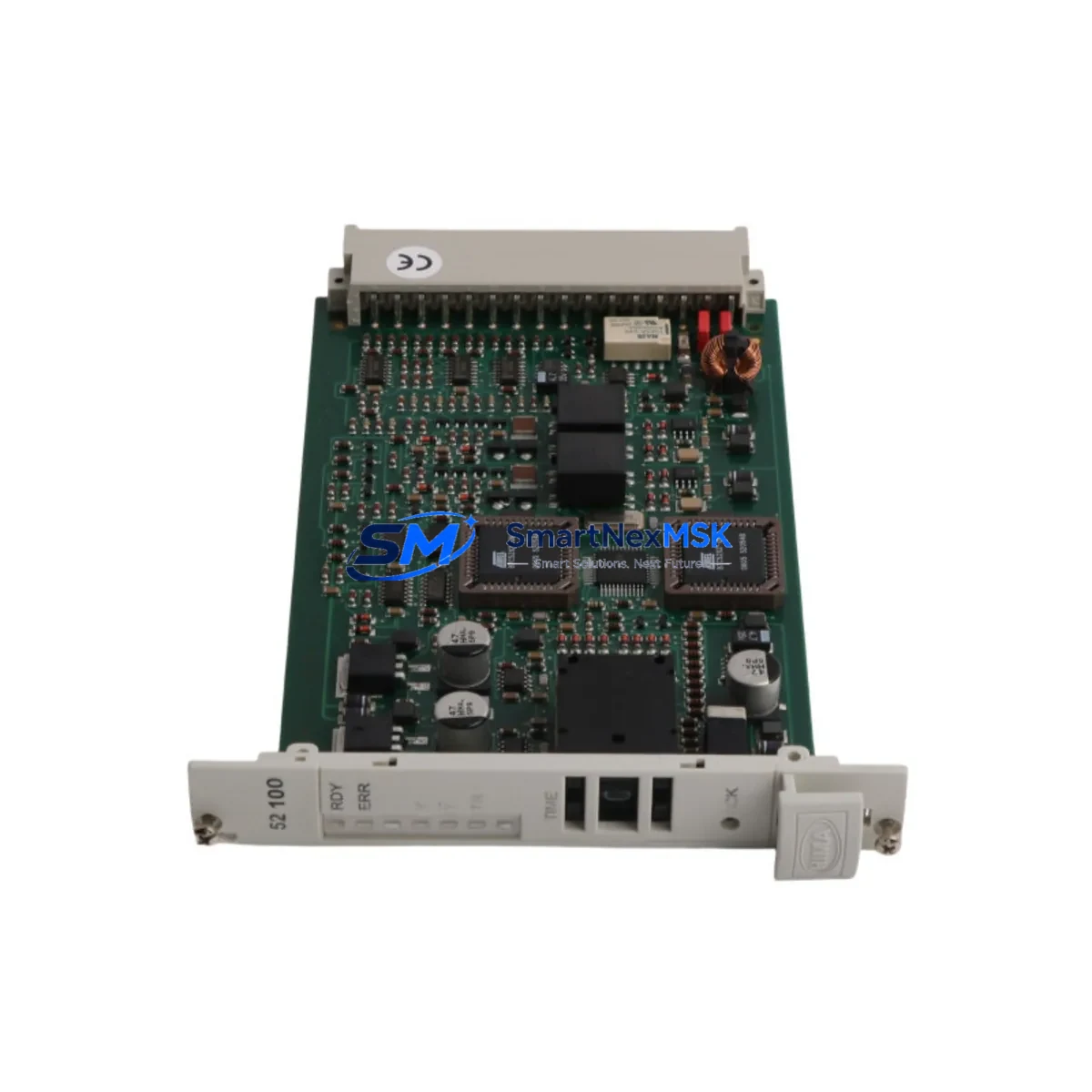
HIMA 52100 Retrofit-Ready Time Delay Module for HIMAX F3 Control Systems
The HIMA 52100 Time Delay Module is a critical component in the HIMAX F3 safety-rated programmable logic controller platform, widely deployed across oil & gas, chemical processing, power generation, and heavy industrial facilities. As legacy HIMAX F3 systems approach end-of-life or require spare-part replenishment, the 52100 module remains one of the most frequently requested retrofit and replacement components — valued for its direct compatibility with existing backplane slots, terminal wiring, and safety-certified program logic.
Whether you are executing a planned control system upgrade, recovering from an unplanned module failure, or building a strategic spare-parts inventory to protect production continuity, the HIMA 52100 offers a verified drop-in replacement path that minimizes engineering rework and eliminates the need for full panel redesign. Our stock is sourced from authorized supply chains, individually tested prior to shipment, and covered by a 12-month warranty against manufacturing defects.
Upgrade Compatibility Table
| Parameter | HIMA 52100 Specification | Retrofit Notes |
|---|---|---|
| Module Type | Time Delay Module | Direct slot-compatible with HIMAX F3 backplane |
| Safety Rating | SIL 2 / SIL 3 (IEC 61508) | Maintains existing SIL certification; no re-validation required for like-for-like swap |
| Backplane Interface | HIMAX F3 standard bus connector | Fits existing rack without mechanical modification |
| Terminal Wiring | Compatible with original field wiring | No rewiring required; verify terminal torque spec before re-energizing |
| Communication Protocol | HIMA internal safety bus | Compatible with HIMAX F3 CPU modules and co-processor cards |
| Module Address | Configured via ELOP II / ELOP II NT engineering tool | Address must match original slot assignment in safety program |
| Power Consumption | Verify against rack power budget | Confirm HIMAX F3 power supply module (e.g. F3 PS) capacity before installation |
| Program Compatibility | Fully compatible with existing ELOP II safety logic | No program modification required for direct replacement |
| Commissioning | Online replacement supported (where system design permits) | Perform functional test and proof-test documentation post-installation |
| Warranty | 12 Months | Covers manufacturing defects; includes pre-shipment functional test report |
Retrofit Planning for Existing Automation Systems
Successful integration of the HIMA 52100 into an operating HIMAX F3 system begins well before the module arrives on site. Engineers should start by auditing the existing rack configuration — confirming the slot position, backplane revision, and the firmware version running on the HIMAX F3 CPU module. In multi-rack installations, the 52100 may be installed in an expansion rack connected via the HIMA F3 rack bus coupler, so verifying the rack address and bus segment assignment is essential before any physical swap.
Power budget verification is a non-negotiable step. The HIMAX F3 power supply module — typically an F3 PS 10/10 or equivalent — must have sufficient headroom to support the 52100 alongside co-installed modules such as digital input modules (F3 DI), digital output modules (F3 DO), and analog input modules (F3 AI). Overloading the power rail is a common cause of intermittent faults in retrofitted panels and must be ruled out before commissioning.
Terminal wiring should be documented with as-built drawings before disconnection. The 52100’s field terminals are compatible with the original wiring harness in standard HIMAX F3 installations, but engineers should inspect terminal blocks for corrosion, verify conductor cross-sections, and re-torque all connections to the manufacturer’s specification. In older installations, it is also advisable to inspect the backplane connector pins for oxidation, particularly in humid or coastal environments.
From a software perspective, the HIMA ELOP II or ELOP II NT engineering environment is used to configure module parameters, assign the module address, and download the safety program. When replacing the 52100 on a like-for-like basis, the existing program logic does not require modification — however, the module’s hardware configuration entry in the project file must be verified to match the physical slot. Any mismatch will trigger a configuration fault on the HIMAX F3 CPU and prevent the system from entering RUN mode.
For facilities that also operate HIMA HIMatrix or H41q controllers in adjacent control loops, it is worth confirming that the safety network topology — including any PROFIBUS DP or Modbus RTU links connecting the HIMAX F3 to distributed I/O panels or third-party DCS systems — remains intact after the module swap. Communication interruptions during replacement can propagate alarms to the DCS historian and HMI operator stations, so coordinating with the control room team before beginning work is strongly recommended.
Downtime Control During System Migration
Minimizing unplanned downtime is the primary operational concern when replacing a time delay module in a live safety system. Where the HIMAX F3 system architecture supports online module replacement — and where the safety function associated with the 52100 can be temporarily bypassed under a formal Management of Change (MOC) procedure — the swap can often be completed within a single maintenance window of two to four hours.
Before initiating the replacement, the original safety program should be backed up from the HIMAX F3 CPU using ELOP II, and the backup file should be stored on an offline engineering workstation. This protects against accidental program loss and provides a verified restore point if the new module requires re-commissioning. The HIMA programming cable (typically a USB or serial interface cable compatible with the F3 CPU’s front-panel port) should be on hand throughout the procedure.
During the physical swap, the HIMAX F3 system’s diagnostic LEDs and the ELOP II online monitoring view provide real-time feedback on module status, power rail health, and communication link integrity. Engineers should monitor the CPU’s fault log immediately after re-energizing the new 52100 to confirm that no configuration mismatches or hardware faults are present. Once the module enters normal operation, a functional proof test — verifying that the time delay function operates within its specified tolerance — should be performed and documented before the bypass is lifted and the safety function is restored to service.
For facilities managing multiple HIMAX F3 racks across a plant, maintaining a small buffer stock of the HIMA 52100 alongside other high-demand spares — such as F3 DI digital input modules, F3 DO output modules, and F3 PS power supply units — is a proven strategy for reducing mean time to repair (MTTR) and protecting production uptime.
Retrofit Support FAQ
Q1: Is the HIMA 52100 a direct drop-in replacement for the original module in my HIMAX F3 system?
Yes. The 52100 is designed for direct slot-compatible installation in the HIMAX F3 backplane. No mechanical modification, rewiring, or program changes are required for a like-for-like replacement. Module address and hardware configuration in ELOP II should be verified to match the original slot assignment before going online.
Q2: What commissioning steps are required after installing the HIMA 52100?
After physical installation, connect the HIMA programming cable to the HIMAX F3 CPU and use ELOP II to verify the hardware configuration, confirm the module address, and check the system fault log. Perform a functional proof test of the time delay function and document the results. If the system was in bypass during replacement, follow your site’s MOC procedure to restore the safety function to service.
Q3: How do I verify wiring compatibility before replacing the module?
Review the as-built terminal drawings for the existing HIMAX F3 panel. The 52100’s terminal layout is compatible with standard HIMAX F3 field wiring. Inspect all conductors for insulation integrity, verify conductor cross-sections against the module’s terminal specification, and re-torque all connections after installation. Pay particular attention to terminal blocks in panels with a history of vibration or thermal cycling.
Q4: What does the 12-month warranty cover, and is a test report included?
Every HIMA 52100 unit shipped by SMARTNEXMSK is functionally tested prior to dispatch. The 12-month warranty covers manufacturing defects and functional failures under normal operating conditions. A pre-shipment test report is available upon request. For warranty claims, contact [email protected] with the order reference and a description of the fault observed.
© 2026 SMARTNEXMSK. All rights reserved.
Original Source: https://smartnexmsk.com
Contact: [email protected] | +86 18259474341