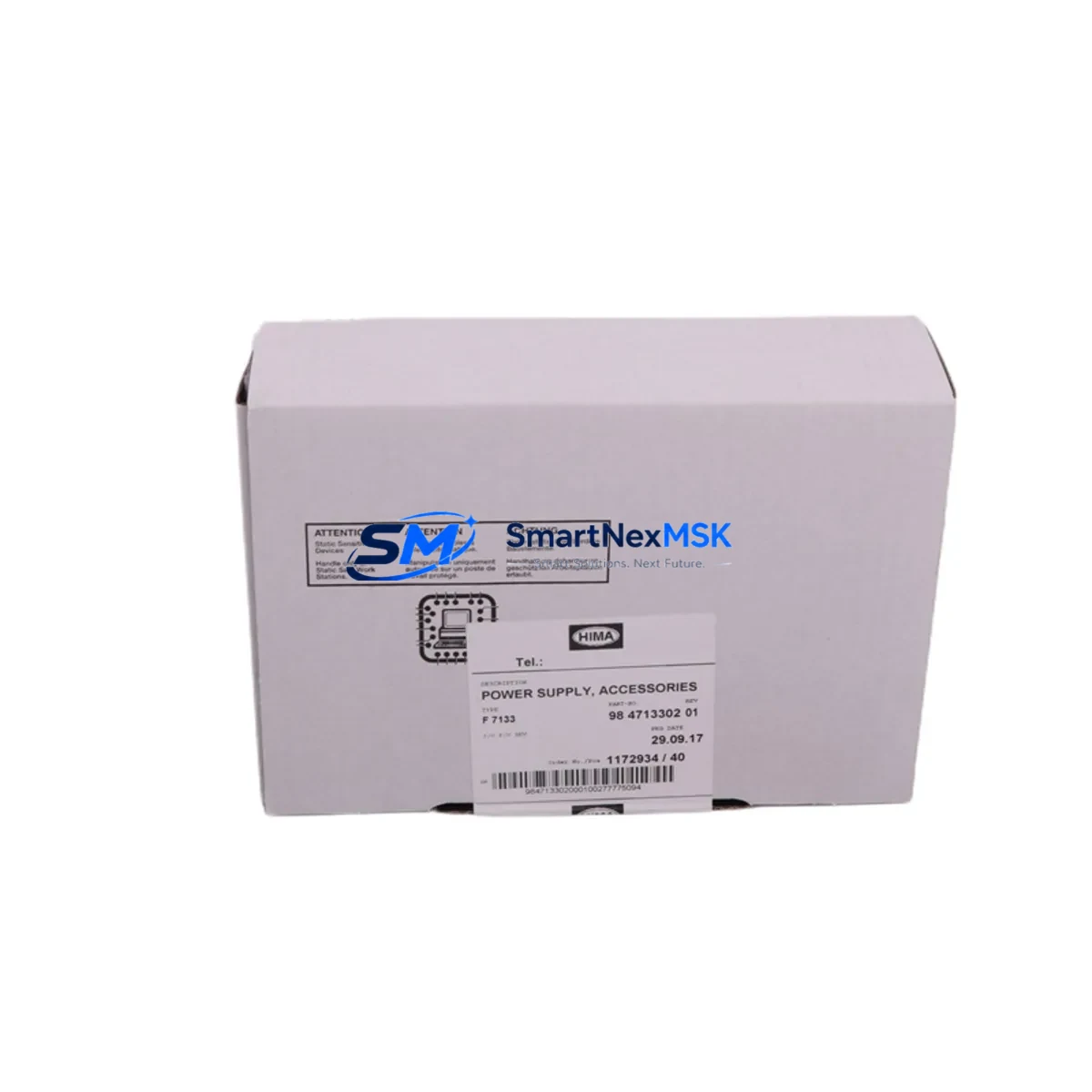
HIMA F7133 Retrofit-Ready Power Distribution for H41q SIS Control Systems
The HIMA F7133 is a 4-channel power distribution module engineered for seamless integration into HIMA H41q Safety Instrumented System (SIS) architectures. As legacy H41q installations approach end-of-life and OEM support windows close, the F7133 has become a critical retrofit component for engineers tasked with extending plant operational life, upgrading control cabinets, and maintaining SIL-rated loop integrity without full system replacement. Whether you are sourcing a direct drop-in spare for a failed unit or executing a planned modernization of an existing safety PLC rack, the F7133 delivers verified compatibility with the H41q backplane, terminal wiring conventions, and HIMA’s proprietary communication architecture.
Procurement teams and system integrators working on brownfield SIS upgrades consistently identify power distribution as the first bottleneck in retrofit planning. The F7133 addresses this by maintaining the same 24 VDC input range, channel isolation characteristics, and DIN-rail mounting footprint as the original H41q power supply modules. This means existing cabinet layouts, cable schedules, and terminal block assignments — including those wired to HIMA F3 DIO modules and F6 communication modules — remain valid without re-engineering. Engineers can validate the replacement against existing loop drawings and I/O lists before committing to installation, significantly reducing the risk of wiring errors during live-system changeovers.
Upgrade Compatibility Table
| Parameter | HIMA F7133 (Retrofit) | Notes |
|---|---|---|
| Target System | HIMA H41q SIS | Direct backplane fit |
| Input Voltage | 24 VDC (18–32 V range) | Compatible with existing PSU wiring |
| Output Channels | 4-channel isolated | Matches original channel mapping |
| Mounting | H41q rack / DIN rail | No mechanical modification required |
| Communication | HIMA proprietary backplane bus | No protocol migration needed |
| SIL Rating | SIL 2 / SIL 3 capable | Verify with project SIL assessment |
| Replacement Scope | Drop-in for discontinued H41q PDM | Confirm firmware revision compatibility |
| Commissioning | Address via HIMA SILworX / ELOP II | No new hardware address required |
| Warranty | 12 Months | Covers manufacturing defects |
Retrofit Planning for Existing Automation Systems
A successful H41q retrofit begins well before the F7133 arrives on site. Engineers should audit the existing rack configuration, confirming the slot position of the power distribution module relative to the HIMA F8621 central processing unit and any installed HIMA F3 DIO or F6 Profibus communication modules. In multi-rack systems, the HIMA F7130 rack coupler and associated backplane cabling must be inspected for wear, as degraded rack interconnects can cause intermittent faults that are incorrectly attributed to the power module itself.
Terminal wiring verification is equally critical. The F7133 uses the same 40-pin front connector standard as other H41q I/O modules, so existing cable harnesses typically transfer without modification. However, engineers should cross-reference the original wiring diagram against the F7133 terminal assignment sheet to confirm channel polarity and fuse ratings. Where the original installation used HIMA F7126 or F7128 power feed modules upstream, the F7133 load profile must be validated against available bus current to avoid overloading the distribution network.
For sites running HIMA ELOP II or the newer SILworX engineering environment, the F7133 does not require a new hardware configuration entry if it is replacing a module of identical type. The existing project file, including all function block logic, safety matrix definitions, and cause-and-effect tables, remains intact. This is a significant advantage over cross-brand migrations, where I/O remapping and full FAT/SAT re-execution are typically mandatory. Sites migrating from third-party SIS platforms to HIMA H41q — for example, from older Triconex or Pilz safety relay architectures — will need to map existing I/O addresses to the H41q slot structure, but the F7133 itself introduces no additional complexity to that process.
Downtime Control During System Migration
Minimizing unplanned downtime is the primary operational constraint in any SIS retrofit. For the F7133 replacement, the recommended approach is a pre-staged hot-swap procedure: the replacement module is bench-tested and verified against the project’s hardware revision list before the maintenance window opens. During the window, the affected safety loop is placed in bypass per the site’s Management of Change (MOC) procedure, the failed module is extracted, the F7133 is inserted into the vacated slot, and the system is powered up in a controlled sequence.
Because the H41q architecture supports redundant power distribution in high-availability configurations, sites with dual-channel power feeds can often complete the swap without triggering a full system shutdown. The HIMA F8621 CPU continues executing the safety program from the redundant channel while the primary power distribution path is restored. After reinsertion, engineers should confirm that all channel status LEDs on the F7133 indicate healthy output, verify that the SILworX diagnostic display shows no active faults on the replaced slot, and re-enable the bypassed safety loop only after a full loop check is completed. This sequence typically keeps total controlled downtime under two hours for a single-module replacement.
Retrofit Support FAQ
Q: Is the HIMA F7133 a direct replacement for all H41q power distribution modules?
A: The F7133 is a direct replacement for the standard 4-channel H41q power distribution module. If your existing installation uses a variant with extended channel count or a different voltage range, confirm the exact part number before ordering. Our technical team can cross-reference your existing module label against the HIMA product matrix.
Q: Do I need to re-download the safety program after installing the F7133?
A: In most cases, no. If the F7133 replaces a module of identical type and the hardware configuration in SILworX or ELOP II is unchanged, the CPU will recognize the module automatically on power-up. A forced download is only required if the hardware configuration file has been modified or if the firmware revision of the replacement module differs from the original.
Q: What wiring checks are required before powering up the replacement module?
A: Verify terminal torque on all 40-pin connector positions, confirm channel polarity against the original loop drawing, and check that upstream fuse ratings match the F7133 input specification. Inspect the backplane connector on the module for bent pins before insertion. These steps prevent the majority of commissioning faults encountered during field replacement.
Q: What does the 12-month warranty cover?
A: The 12-month warranty covers manufacturing defects and functional failures under normal operating conditions. Each unit undergoes pre-shipment functional testing. Warranty claims are processed with full technical support, and replacement units are dispatched from stock to minimize your system downtime.
© 2026 SMARTNEXMSK. All rights reserved.
Original Source: https://smartnexmsk.com
Contact: [email protected] | +86 18259474341