
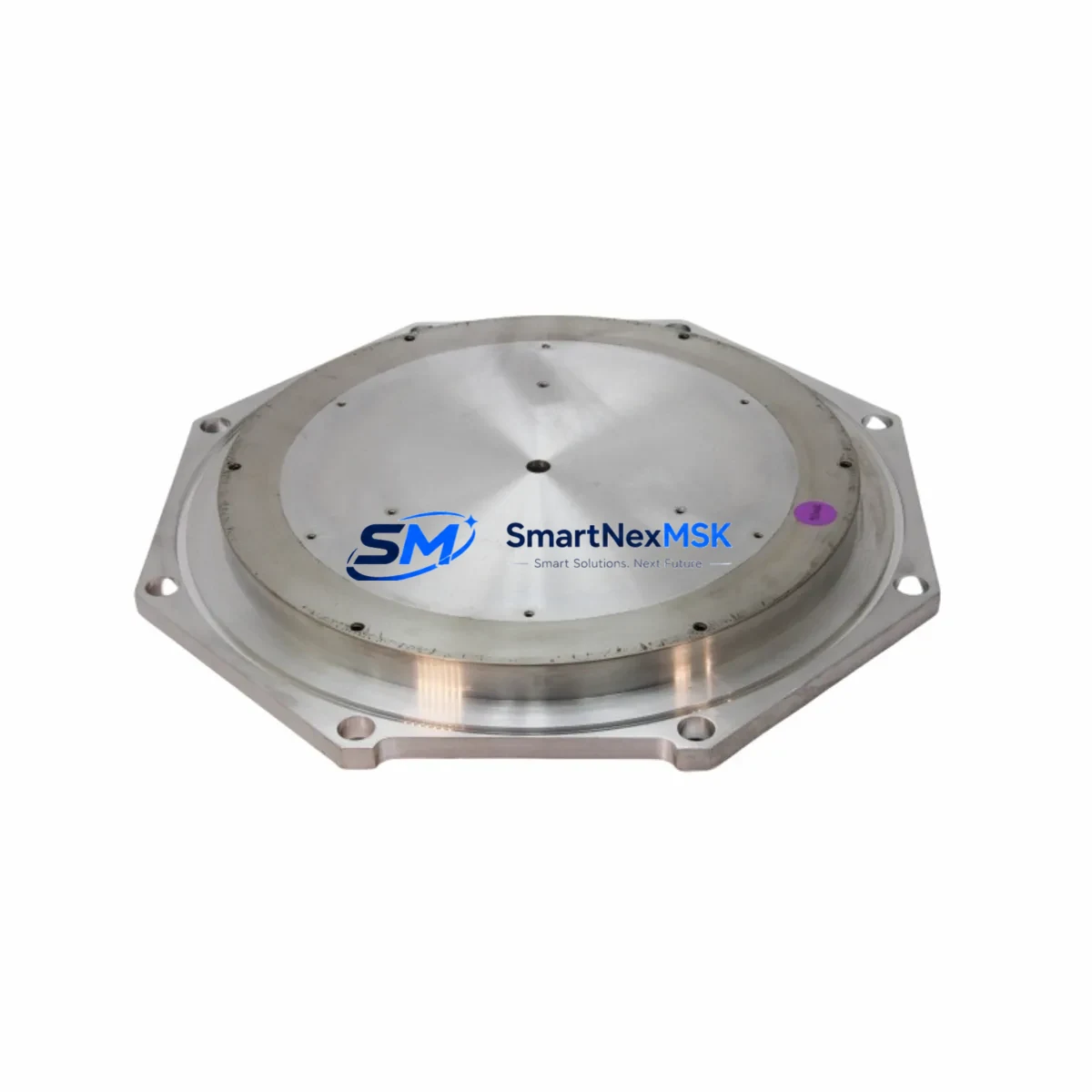
LEM LF 1005-S/SP16 Retrofit-Ready Current Transducer for LFSP Series Control Systems
The LEM LF 1005-S/SP16 is a closed-loop Hall effect current transducer rated at 1005 A nominal primary current, designed as a precision retrofit replacement for legacy LFSP Series transducers deployed across industrial drive systems, traction inverters, UPS installations, and high-power motor control cabinets. As original LFSP Series units reach end-of-life or become unavailable through standard distribution channels, the LF 1005-S/SP16 provides a dimensionally compatible, electrically equivalent upgrade path that preserves existing wiring harnesses, PCB footprints, and control loop calibration — minimising both engineering rework and unplanned downtime.
Manufactured by LEM (Switzerland), the LF 1005-S/SP16 operates on a ±15 V or ±12 V dual supply and delivers a secondary nominal current of 100 mA with a conversion ratio of 1:10050. The SP16 variant integrates a 16-pin connector interface, enabling direct substitution in panel assemblies where the original LFSP connector harness remains intact. Accuracy class is typically ±0.5% at nominal current, with a response time under 1 µs — performance characteristics that satisfy the closed-loop feedback requirements of modern IGBT-based inverter platforms and legacy thyristor drive controllers alike.
When planning a retrofit around the LF 1005-S/SP16, engineers should verify the following before commissioning: primary conductor aperture clearance (busbar or cable routing through the 35 mm window), secondary burden resistance at the measurement input of the controller card, supply rail voltage tolerance at the transducer terminals, and the polarity convention of the existing wiring relative to the replacement unit’s pin assignment. In systems where the original LFSP transducer fed an analogue input on a Siemens SIMOREG DC Master or ABB DCS800 thyristor drive, the secondary output scaling must be confirmed against the drive’s current feedback parameter set before live commissioning.
For retrofit projects involving variable frequency drives such as the ABB ACS880 or Siemens SINAMICS S120, the LF 1005-S/SP16 is commonly installed alongside replacement gate driver boards, DC link capacitor banks, and IGBT power modules during a scheduled overhaul. In these scenarios, the transducer is typically mounted on the DC bus or AC input busbar, with its secondary output routed to the drive’s current feedback terminal block — a connection point that may also interface with a Siemens ET 200SP or ET 200M analogue input module in distributed I/O architectures.
In traction and renewable energy applications, the LF 1005-S/SP16 is frequently paired with LEM LA 305-S or LEM LA 505-S transducers on lower-current phases, allowing a mixed-rating measurement architecture within a single control cabinet. Where the original system used a LEM LFSP 500-S or LEM LFSP 1000-S on the main bus and supplementary transducers on branch circuits, the upgrade path typically involves replacing the main bus unit with the LF 1005-S/SP16 while retaining or upgrading the branch units in parallel. Engineers should document the full transducer map before beginning any replacement sequence to avoid measurement gaps during partial commissioning.
Power supply integrity is a critical pre-commissioning check. The LF 1005-S/SP16 draws approximately 25 mA per supply rail under no-load conditions, rising to around 60 mA at full primary current. In cabinets where multiple transducers share a common ±15 V auxiliary supply — sourced from a Phoenix Contact QUINT-PS or equivalent DIN-rail PSU — the aggregate current draw must be recalculated after adding the replacement unit, particularly if the original LFSP variant had a different supply current profile. Failure to account for this can cause supply rail droop, introducing measurement offset errors that are difficult to diagnose without a calibrated reference.
Terminal block and busbar adaptation is straightforward in most installations. The LF 1005-S/SP16 mounts via M5 or M6 fixing points compatible with standard DIN rail adapter brackets. Primary conductor routing through the aperture requires no modification in most retrofit scenarios, provided the original cable or busbar cross-section falls within the transducer’s rated window dimensions. Where busbars have been upsized as part of a capacity upgrade, a new aperture bracket or saddle clamp may be required — a minor mechanical adaptation that does not affect electrical performance.
All units supplied by SMARTNEXMSK are sourced from authorised distribution channels or verified surplus stock, subject to incoming inspection including insulation resistance testing, secondary output verification at 25%, 50%, and 100% of nominal primary current, and connector integrity checks. Each unit ships with a 12-month warranty covering manufacturing defects and measurement accuracy drift beyond published specifications. Expedited dispatch is available for urgent breakdown and line-down situations, with same-day shipment on confirmed stock from our Xiamen warehouse.
Upgrade Compatibility Table
| Parameter | Legacy LFSP Series (e.g. LFSP 1000-S) | LEM LF 1005-S/SP16 (Replacement) |
|---|---|---|
| Nominal Primary Current (IPN) | 1000 A | 1005 A |
| Secondary Nominal Current | 100 mA | 100 mA |
| Conversion Ratio | 1:10000 | 1:10050 |
| Supply Voltage | ±15 V (±12 V compatible) | ±15 V (±12 V compatible) |
| Connector Interface | LFSP series connector | SP16 16-pin connector (direct fit) |
| Aperture (Primary Window) | 35 mm × 35 mm (typical) | 35 mm × 35 mm |
| Mounting | Panel / DIN bracket | Panel / DIN bracket (M5/M6) |
| Accuracy Class | ±0.5% | ±0.5% |
| Response Time | <1 µs | <1 µs |
| Communication Compatibility | Analogue output (secondary current) | Analogue output (secondary current) |
| Retrofit Recommendation | — | Direct drop-in; verify burden resistor value |
| Commissioning Focus | — | Polarity, supply rail load, secondary scaling |
| Warranty | — | 12 months (SMARTNEXMSK) |
Retrofit Planning for Existing Automation Systems
A successful retrofit begins with a complete audit of the existing measurement chain. In a typical high-power drive cabinet, the LF 1005-S/SP16 sits at the top of a measurement hierarchy that may include LEM LA 305-S transducers on auxiliary motor branches, a Phoenix Contact QUINT-PS/3AC/24DC/20 or similar PSU feeding the ±15 V rails, and a Siemens SIMATIC S7-300 or S7-400 PLC receiving the analogue feedback via a SM 331 analogue input module. Before removing the legacy LFSP unit, engineers should record all parameter settings in the drive or controller that reference the transducer’s scaling factor — particularly the current feedback gain, offset trim, and overcurrent trip threshold.
In systems using a Siemens SIMOREG DC Master 6RA70 or 6RA80 thyristor drive, the armature current feedback is typically configured via parameter P100 (rated motor current) and P101 (current controller gain). After installing the LF 1005-S/SP16, these parameters should be re-verified against the new transducer’s conversion ratio to ensure the drive’s current loop remains stable. Similarly, in ABB DCS800 installations, the current feedback scaling is set via parameter 99.03 and related current controller parameters — a step that must not be skipped even when the replacement unit appears electrically identical.
For distributed I/O architectures using Siemens ET 200SP or Beckhoff EL3202 analogue input terminals, the transducer’s secondary output connects to a current input channel configured for 0–100 mA or ±100 mA range. After replacement, the channel’s engineering unit scaling should be re-confirmed in the PLC program — particularly if the original LFSP unit had a slightly different conversion ratio that was compensated in software. In PROFIBUS or PROFINET-based systems, no communication reconfiguration is required, as the transducer itself is a passive analogue device; however, the analogue input module’s hardware configuration in the GSD/GSDML file should be reviewed if the module itself is also being replaced as part of the upgrade.
Where the retrofit is part of a broader control cabinet upgrade involving a new Siemens SINAMICS S120 booksize chassis with a CU320-2 PN control unit, the LF 1005-S/SP16 may feed into the drive’s external current feedback interface rather than a separate PLC input. In this configuration, the transducer’s secondary output connects directly to the drive’s TB30 terminal block, and the feedback scaling is configured via STARTER or Startdrive commissioning software. Engineers should confirm the TB30 input impedance against the transducer’s specified burden resistance range before finalising the wiring.
Downtime Control During System Migration
Minimising production downtime during a current transducer replacement requires a structured pre-outage preparation sequence. Before the planned maintenance window, engineers should complete the following offline steps: obtain and review the existing PLC program backup (including all analogue scaling blocks and current feedback rungs), photograph the existing wiring at the transducer terminals and connector, record the live secondary output value at a known primary current level for post-replacement verification, and confirm that the replacement LF 1005-S/SP16 unit has passed incoming inspection.
During the outage, the physical replacement sequence should follow a defined order: isolate the primary conductor (de-energise and lock out the main circuit), disconnect the secondary connector, remove the legacy LFSP unit from its mounting bracket, install the LF 1005-S/SP16 using the same bracket or a compatible adapter, reconnect the secondary connector (verifying pin assignment against the wiring photograph), and restore the primary conductor. The entire mechanical exchange typically takes under 30 minutes for an experienced technician familiar with the cabinet layout.
Post-replacement commissioning should be performed at reduced primary current before returning the system to full load. Apply a known test current through the primary aperture (using a calibrated current source or by running the motor at a controlled low-speed setpoint) and verify that the secondary output matches the expected value within the transducer’s accuracy specification. Compare the live feedback reading in the PLC or drive HMI against the pre-replacement baseline recorded during preparation. If the reading deviates by more than 1%, recheck the burden resistor value, supply rail voltage, and connector pin assignment before proceeding to full-load operation.
In systems where the original control program includes a current feedback plausibility check or a “transducer fault” diagnostic rung, the engineer should temporarily disable or bypass this logic during the commissioning phase to prevent nuisance trips while the feedback loop is being re-established. Once the system has been verified at full load, the diagnostic logic should be re-enabled and the trip threshold re-confirmed. All commissioning steps, parameter changes, and verification results should be documented in the site maintenance record for future reference.
Retrofit Support FAQ
Q1: Is the LEM LF 1005-S/SP16 a direct drop-in replacement for the LEM LFSP 1000-S?
In the majority of installations, yes. The LF 1005-S/SP16 shares the same aperture dimensions, supply voltage range, secondary nominal current, and SP16 connector interface as the LFSP 1000-S. The nominal primary current differs slightly (1005 A vs. 1000 A), which results in a marginally different conversion ratio (1:10050 vs. 1:10000). In most industrial applications this difference is within the system’s measurement tolerance and requires no parameter adjustment. However, in precision metering or protection relay applications where the current scaling is set to tight tolerances, the drive or PLC parameter governing current feedback gain should be updated to reflect the new ratio.
Q2: What pre-shipment testing is performed on each unit?
Every LEM LF 1005-S/SP16 unit supplied by SMARTNEXMSK undergoes incoming inspection including: visual and mechanical integrity check, insulation resistance test between primary and secondary circuits, secondary output verification at 25%, 50%, and 100% of nominal primary current using a calibrated current source, and connector pin continuity check. Units that fail any inspection criterion are quarantined and not dispatched. A 12-month warranty covering manufacturing defects and out-of-specification measurement accuracy is included with every unit.
Q3: How do I verify correct wiring polarity after installation?
With the primary circuit energised at a known positive current direction (e.g., motor accelerating in the forward direction), the secondary output should produce a positive current at the designated output pin as defined in the LEM LF 1005-S/SP16 datasheet. If the drive or PLC displays a negative current feedback value under these conditions, the secondary connector polarity is reversed — correct by swapping the secondary output and return connections at the terminal block. Do not reverse the primary conductor routing through the aperture, as this may affect the transducer’s magnetic shielding performance.
Q4: What is the lead time and warranty coverage?
In-stock units ship from our Xiamen warehouse within 1–2 business days of order confirmation. Expedited same-day dispatch is available for urgent breakdown situations — contact [email protected] or call +86 18259474341 to confirm stock availability and arrange priority shipment. All units carry a 12-month warranty from the date of dispatch, covering manufacturing defects and measurement accuracy drift beyond LEM’s published specifications. Warranty claims are processed via direct RMA with SMARTNEXMSK; replacement units are dispatched within 3 business days of fault confirmation.
© 2026 SMARTNEXMSK. All rights reserved.
Original Source: https://smartnexmsk.com
Contact: [email protected] | +86 18259474341