
Yokogawa Lifecycle Planning: CENTUM Spare Guide
Plan Yokogawa CENTUM spares with practical checks for installed-base evidence, I/O coverage, lifecycle risk, repair paths, and maintenance RFQs.
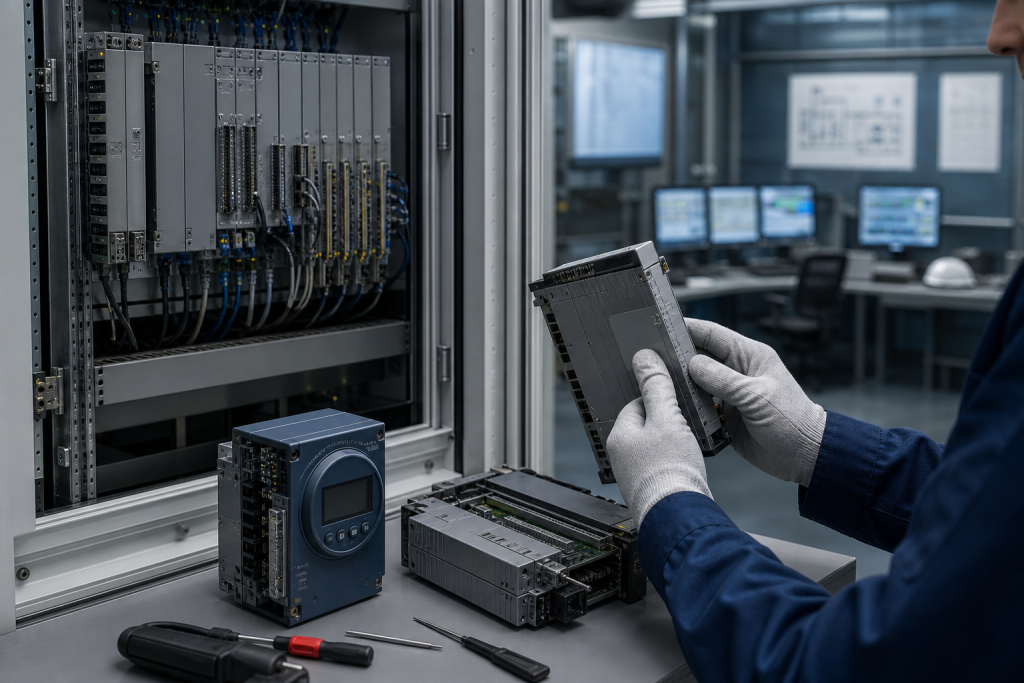
Process plants often keep Yokogawa control systems in service for years because the installed configuration is stable, documented, and deeply connected to production operations. The lifecycle challenge appears when a controller, I/O module, power supply, or analyzer interface becomes difficult to identify or replace. At that point, the plant needs more than a list of old part numbers. It needs a controlled view of installed assets, spare coverage, repair options, and modernization timing.
Yokogawa’s 2026 lifecycle service material describes proactive lifecycle protection, smarter spares management, upgrades, and support for installed systems. For maintenance and MRO teams, the practical lesson is to move lifecycle review earlier, while the control system still has usable documentation and a realistic recovery path.
Start with the installed CENTUM configuration
A CENTUM spare plan should begin with the actual system configuration rather than the product family name. Record the system generation, station or node role, controller identity, I/O type, communication path, power arrangement, cabinet location, and the engineering tools used for configuration and recovery.
For each critical module, capture the full order code, suffix, hardware revision, firmware context, quantity installed, quantity held, and the process function it supports. A module that looks similar may have a different signal type, connector, isolation design, or software dependency. A clear nameplate photo and cabinet location often provide better evidence than a shortened spreadsheet description.
Separate control, I/O, and support-system risk
Not every spare has the same recovery value. A failed controller can stop an entire process area, while a single non-critical input card may be bypassed temporarily. Classify each item by function and consequence:
- Control and processing: controller modules, processor units, station hardware, and critical power assemblies.
- Signal and I/O: analog input, analog output, digital I/O, termination, and signal-conditioning modules.
- Communication: network interfaces, gateways, serial links, and system interconnection hardware.
- Support systems: engineering workstations, storage media, configuration tools, and project backups.
This classification prevents a plant from counting ten low-consequence cards as coverage for one missing controller or communication path. It also makes a replacement RFQ easier to prioritize when budget or lead time is limited.
Review lifecycle status before an outage
A lifecycle review should answer four questions. Is the exact part still available as a new unit? Is repair or exchange support realistic? Is there a verified alternative or upgrade path? What evidence is needed before the plant can accept a substitute?
Yokogawa’s lifecycle approach emphasizes proactive asset review rather than waiting for a failure. For a buyer, that means recording the date of the last model verification, the source and condition of each spare, the last functional test, and the next planned review. The result should be a risk register with clear actions, not a static archive.
Where a CENTUM installation includes older analog or processing modules, a real product record can help the team organize the request. For example, an NP53*C spare for CENTUM VP or CS 3000 may require different verification from a Yokogawa AAI141-S00 analog input module. The correct sourcing path depends on the exact installed model, revision, application, and required condition.
Use repair, exchange, and upgrade as separate paths
When an original part is hard to source, do not treat every alternative as a direct replacement. An exact spare, a repaired unit, an exchange unit, a form-fit replacement, and a modernization option each carry different evidence and validation requirements.
Ask which path is being quoted and what has been tested. For repair or exchange, request the inspection scope, failure report if available, replaced components, test conditions, warranty boundary, and expected turnaround. For a replacement or upgrade, confirm signal mapping, engineering software, communications, cabinet changes, configuration conversion, commissioning requirements, and rollback planning.
Prepare a better Yokogawa RFQ
A maintenance-ready RFQ should include the complete part number, system or cabinet location, installed quantity, required spare quantity, condition preference, destination, urgency, and the reason for the request. Add photos of the label, front and rear connectors, terminal arrangement, and cabinet position when possible.
Also state whether the request is for emergency recovery, planned shutdown stock, a repair or exchange review, or a modernization project. This prevents a supplier from treating a high-consequence control module like a generic catalog item. It also gives the technical reviewer enough context to separate exact-model sourcing from replacement analysis.
FAQ: Yokogawa lifecycle and spare planning
How often should a Yokogawa installed base be reviewed?
Review critical control and communication assets at least annually and whenever the plant changes a controller, software environment, network path, or maintenance strategy. Increase the review frequency when a product enters a limited or uncertain lifecycle stage.
Is a CENTUM spare plan only about controller modules?
No. I/O, termination, power, communication, engineering workstations, storage media, software versions, and project backups can all affect recovery. The plan should cover the complete control path required to restart the process.
What should be checked before accepting a refurbished module?
Confirm the exact model and revision, inspection or test scope, condition description, serial or traceability evidence, warranty, packing, and any configuration or compatibility limitations. Receiving inspection should compare the unit with the installed record.
When should a plant consider modernization instead of another spare?
Consider modernization when exact spares are repeatedly difficult to source, the engineering environment is unsupported, recovery depends on unavailable knowledge, or a planned outage can reduce future lifecycle risk. The decision should include validation effort and rollback planning.
Make lifecycle information usable
Lifecycle planning works when every critical Yokogawa asset has an identifiable model, a realistic recovery path, and an owner for the next review. SmartNexMSK can help organize model lists, label photos, repair or exchange requirements, replacement questions, and delivery targets through [email protected] or WhatsApp/Phone +86 18259474341. Send the installed model and process context so the sourcing route can be reviewed with the right evidence.
Route this topic into a sourcing request
Connect the article topic to a model number, category, brand, quantity, and destination before opening the RFQ.
Related Insights
Continue with sourcing and model matching guides
 Sep 8, 2026
SANYO DENKI QS1E Spares: Save Parameters First
When a SANMOTION Q axis stops, the purchasing request often becomes a model number: “Please quote QS1E01AA0H4A3P1T.” That is a useful starting point, but…
Read guide Sep 6, 2026
Yaskawa SGDH-05DE-OY Spares: Check the Servo Chain
A servo drive fault often produces a deceptively simple purchasing request: “Replace the SGDH-05DE-OY.” In a running machine, however, the amplifier is only one…
Read guide Sep 5, 2026
GE IS220PCLAH1A Spares: Check Mark VIe Fit
When a Mark VIe cabinet develops an intermittent control fault, the urgent request often becomes a single line: “Please quote IS220PCLAH1A.” That is understandable…
Read guide