
Obsolete PLC Spare Inventory Planning: A Practical Framework
Plan obsolete PLC spares with a practical framework for criticality, model evidence, replacement risk, testing, and MRO procurement decisions.
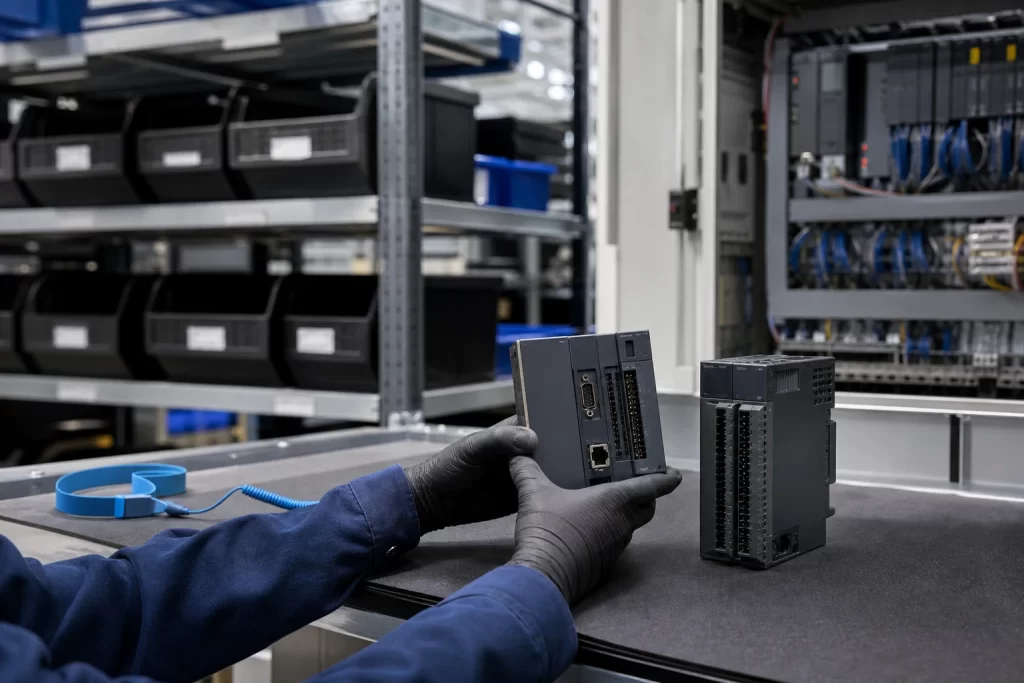
An obsolete PLC rarely becomes a production risk on the day a manufacturer publishes an end-of-life notice. The risk usually appears later, when the plant discovers that its last Siemens S7-300 CPU spare is already installed, a remote I/O module has an unknown revision, or the original programming workstation cannot restore a tested project.
For maintenance and MRO teams, the practical question is not simply how many PLC modules are in the storeroom. It is whether the inventory can support a known failure, a realistic replacement path, and a controlled restart. A useful obsolete PLC spare plan connects equipment criticality, model evidence, compatibility, test status, and lead-time exposure.
Start with the control function, not the part number
Part numbers are essential, but they should be the second layer of the review. Begin by listing the machine, process, or safety function supported by each controller. A spare for a non-critical conveyor and a spare for a batch reactor may look similar in a spreadsheet, yet their business impact and validation requirements are very different.
For every legacy controller, record the process function, controlled assets, shutdown consequence, recovery time target, and whether a temporary manual procedure exists. This establishes a risk priority before the team spends money on additional inventory.
Build an evidence record for every legacy module
A reliable inventory record should include the complete manufacturer part number, hardware revision, firmware version, series, communication interface, power requirement, installed location, and current quantity. Add clear photos of the nameplate, terminal side, connectors, front label, and any revision stickers. For a replacement decision, the photo often resolves an ambiguity that a shortened material code cannot.
Record whether the item is new, refurbished, repaired, exchange stock, or surplus. These terms are not interchangeable. A surplus unit may be unused but untested. A refurbished unit may have passed electrical checks but still require a compatibility review. The buyer needs the condition, evidence, warranty boundary, and test scope before comparing prices.
Separate failure coverage from project coverage
Plants often mix two different goals in one spare count. Failure coverage protects production against an unexpected module failure. Project coverage supports a planned expansion, migration, or equipment move. Keep these quantities separate. Otherwise, a project reservation can silently consume the only emergency spare for a running line.
For critical PLC systems, consider a minimum of one verified replacement for each unique CPU and communications path, then review I/O quantities based on failure history, environmental exposure, and the time required to rewire or configure the module. A single common-looking I/O card may still differ by voltage, channel arrangement, isolation, connector, or firmware family.
Check the replacement path before buying more stock
Holding more obsolete hardware is not always the safest answer. Compare the cost and availability of additional legacy spares with a controlled replacement plan. The review should ask whether the existing program can be restored, whether the replacement supports the same network and HMI interfaces, whether cabinet space and power are adequate, and whether the change requires a new software license or engineering workstation.
Use the replacement risk checklist for obsolete automation parts to structure the review. Where the exact CPU or I/O identity is uncertain, prepare a model-verification request with the right label and connector photos before asking for a substitute. For large mixed inventories, the mixed-brand spare list workflow helps separate exact models from replacement candidates.
Use a procurement scorecard
A useful RFQ for obsolete PLC spares should request more than unit price. Ask for the exact model and revision, condition, test evidence, available quantity, warranty period, packing method, estimated ship date, and any known compatibility limitation. If a replacement is proposed, request a written distinction between an exact model, a form-fit replacement, and a functionally compatible alternative.
Rank each sourcing option against production risk. A lower-priced unit with no revision evidence may create more exposure than a tested unit with a documented warranty. For high-consequence systems, include a receiving inspection, serial-number record, visual comparison, and bench or offline test before the item enters the emergency shelf.
FAQ: obsolete PLC spare planning
How many obsolete PLC spares should a plant hold?
There is no universal number. Start with process criticality, unique model count, failure history, supplier lead time, and the time needed to validate a replacement. Critical systems normally need at least one verified recovery path for each unique controller family.
Is a surplus PLC module safe to use as an emergency spare?
It may be useful, but surplus status alone does not prove function, firmware compatibility, or storage condition. Request test evidence and perform receiving checks before assigning it to a critical emergency role.
Should a plant keep buying old PLCs or migrate?
The decision depends on remaining installed base, software and engineering support, process downtime tolerance, and the availability of trustworthy spares. A staged migration plan can be safer than repeatedly adding unverified legacy stock.
What information should be included in a replacement RFQ?
Include the full model, revision, firmware, voltage, I/O or communication details, installed application, quantity, destination, urgency, photos, and whether the request is for an exact model or a compatibility review.
Turn the inventory into a maintenance decision
An obsolete PLC inventory is valuable only when the team knows what each item can recover, how quickly it can be tested, and what the next replacement step will be. SmartNexMSK can review model lists, label photos, condition requirements, and delivery targets through [email protected] or WhatsApp/Phone +86 18259474341. Send the current part numbers and the affected process context so the sourcing path can be evaluated with the right level of evidence.
Route this topic into a sourcing request
Connect the article topic to a model number, category, brand, quantity, and destination before opening the RFQ.
Related Insights
Continue with sourcing and model matching guides
 Sep 8, 2026
SANYO DENKI QS1E Spares: Save Parameters First
When a SANMOTION Q axis stops, the purchasing request often becomes a model number: “Please quote QS1E01AA0H4A3P1T.” That is a useful starting point, but…
Read guide Sep 6, 2026
Yaskawa SGDH-05DE-OY Spares: Check the Servo Chain
A servo drive fault often produces a deceptively simple purchasing request: “Replace the SGDH-05DE-OY.” In a running machine, however, the amplifier is only one…
Read guide Sep 5, 2026
GE IS220PCLAH1A Spares: Check Mark VIe Fit
When a Mark VIe cabinet develops an intermittent control fault, the urgent request often becomes a single line: “Please quote IS220PCLAH1A.” That is understandable…
Read guide