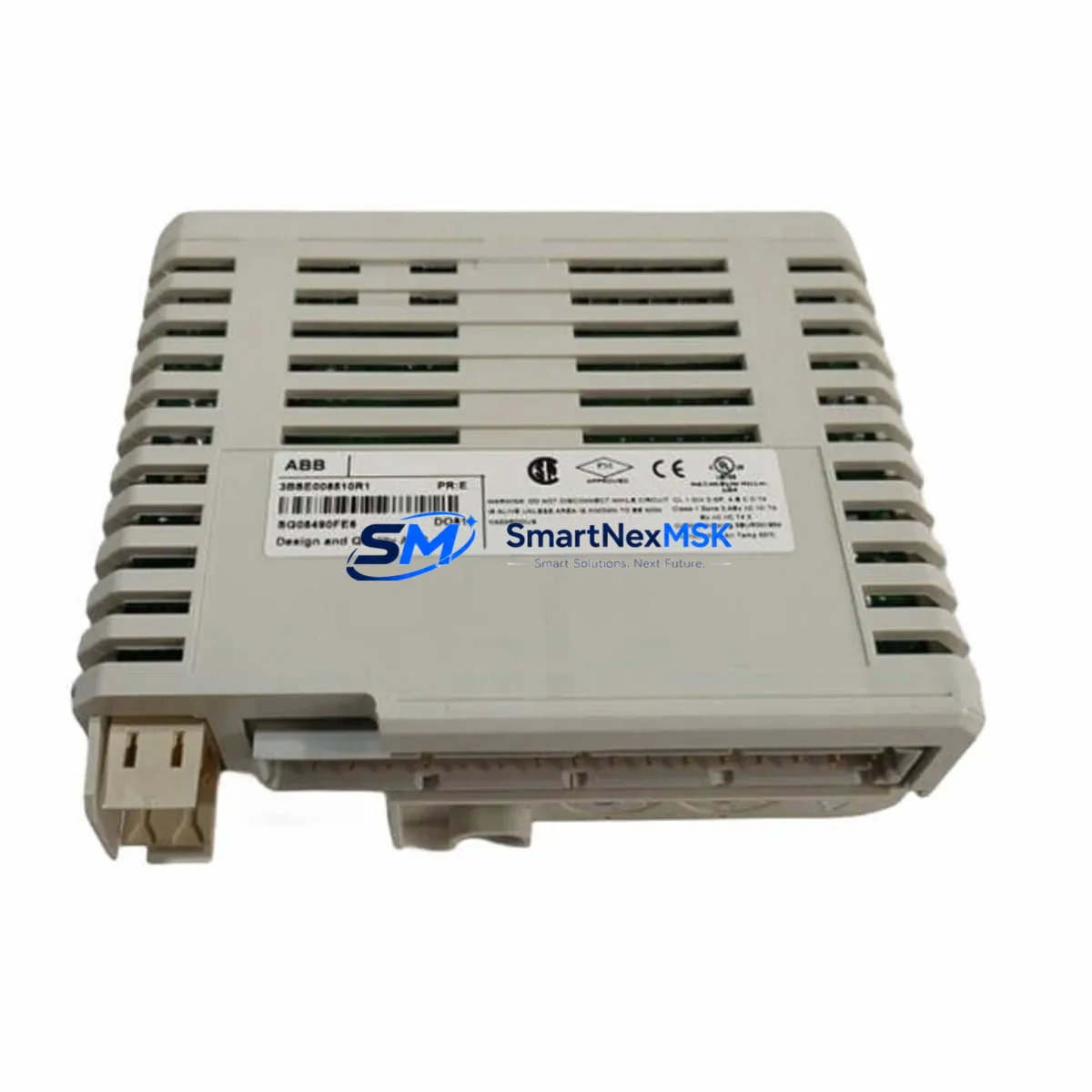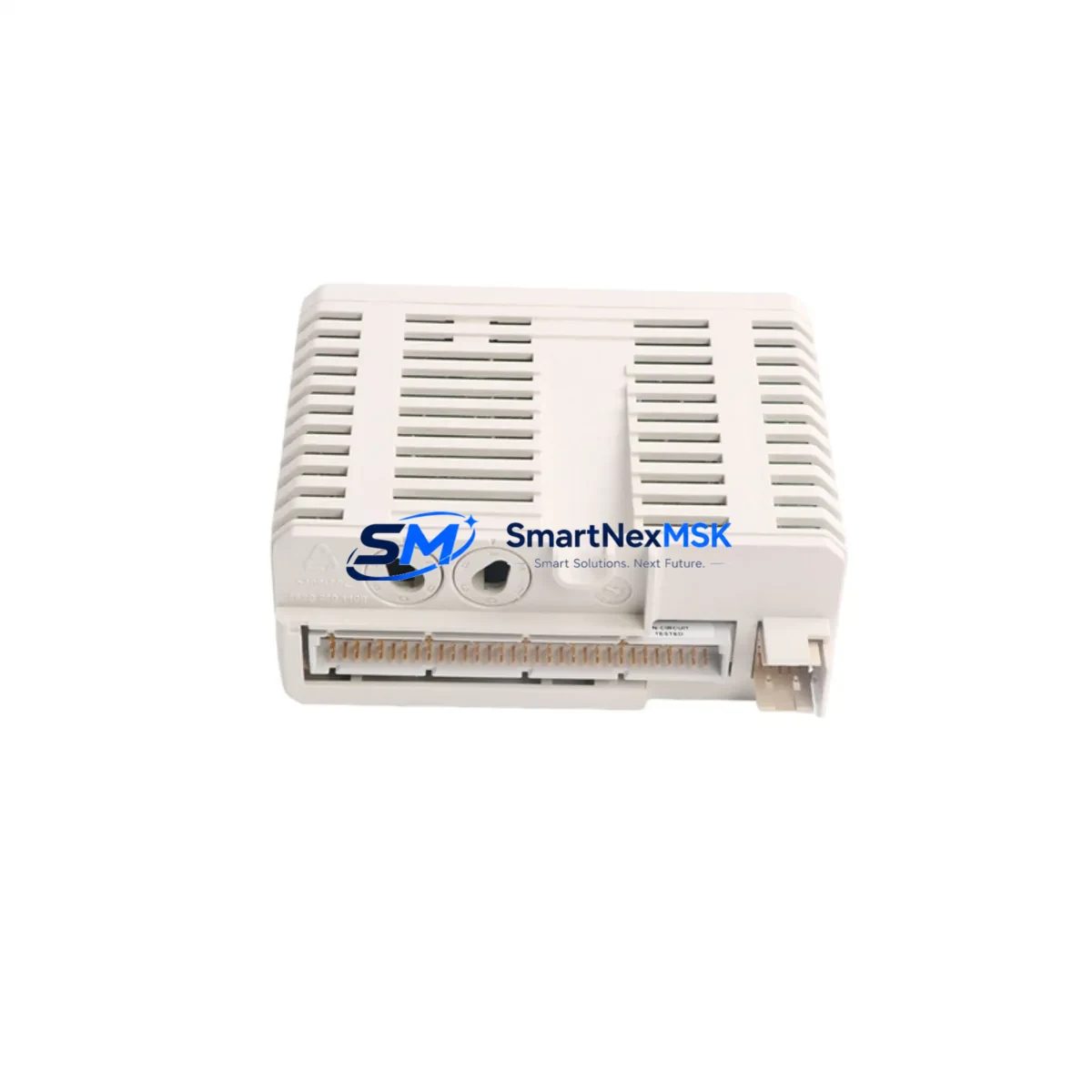
ABB AI830 3BSE008518R1 Retrofit-Ready RTD Input for S800 I/O Control Systems
The ABB AI830 (3BSE008518R1) is an 8-channel RTD analog input module engineered for the ABB S800 I/O platform, widely deployed across AC800M Distributed Control System (DCS) architectures in power generation, oil & gas, chemical processing, and heavy manufacturing. As legacy S800 installations age and original spare parts become increasingly scarce, the AI830 3BSE008518R1 has become a critical retrofit component for engineers tasked with sustaining plant uptime without full system replacement.
This module supports PT100, PT200, PT500, PT1000, Ni100, and Ni1000 RTD sensor types across all 8 channels, with individual channel configuration via the AC800M Controller Builder or System 800xA engineering environment. Its compact ModuleBus form factor allows direct installation into existing TB820V2 or TB840A modem base units without mechanical modification, making it a true drop-in replacement for failed or end-of-life AI830 units already in service.
Upgrade Compatibility Table
| Parameter | Detail |
|---|---|
| Replaced / Superseded Models | AI830 (earlier hardware revisions), 3BSE008518R1 legacy stock |
| Compatible Base Units | TB820V2, TB840A (S800 I/O ModuleBus) |
| Compatible Controllers | AC800M (PM860, PM861, PM864, PM866), AC800F |
| Communication Interface | ModuleBus (optical or electrical via TB820V2 / TB840A) |
| Input Channels | 8 × RTD (PT100 / PT200 / PT500 / PT1000 / Ni100 / Ni1000) |
| Installation Requirement | Hot-swap capable on powered S800 I/O station (verify with site SOP) |
| Address Configuration | Automatic via ModuleBus; module address set by slot position |
| Firmware Compatibility | Compatible with AC800M firmware 5.x and above |
| Retrofit Wiring Change | None — terminal block layout identical to prior AI830 revisions |
| Warranty | 12 Months from date of shipment |
Retrofit Planning for Existing Automation Systems
Successful integration of the AI830 3BSE008518R1 into an aging control system begins well before the module arrives on site. Engineers should first audit the existing S800 I/O station to confirm the installed base unit type — whether a TB820V2 modem base or a TB840A redundant base — as this determines the ModuleBus topology and the optical fiber or copper link back to the AC800M controller. Power budget verification is equally important: each S800 I/O station draws supply from a dedicated SD821 or SD822 power supply unit, and adding or replacing modules requires confirming that the station’s total current draw remains within the PSU’s rated output.
Terminal wiring for RTD inputs on the AI830 follows a 3-wire or 4-wire connection scheme. Before removal of the failed module, technicians should photograph or document the existing terminal block wiring against the as-built drawings. The TB820V2 base unit’s terminal block remains in place during module swap, so field wiring is undisturbed — a significant advantage over older S100 or S400 I/O architectures that required full rewiring during upgrades.
For sites running System 800xA, the replacement AI830 will be automatically recognized by the AC800M PM864 or PM866 controller upon insertion, provided the hardware configuration in the Control Builder project matches the installed slot position. If the project was originally built on an older version of Control Builder, engineers should verify that the AI830 hardware library object version is compatible with the current firmware. In most cases, no program changes are required — the existing function block connections to ANALOGIN or RTD_INPUT function blocks remain valid.
Sites that also operate AI820 (4–20 mA analog input) or AI835 (HART-enabled analog input) modules in adjacent slots should note that the AI830 occupies a standard single-width slot and does not interfere with neighboring module addressing. If the retrofit scope extends to communication infrastructure, verify that the CI854A PROFIBUS DP communication interface or CI858 DNP3 module on the same rack is not affected by the station power rebalancing.
Downtime Control During System Migration
Minimizing unplanned downtime is the primary concern for any brownfield retrofit involving the AI830 3BSE008518R1. The S800 I/O platform’s hot-swap architecture allows module replacement without de-energizing the entire I/O station, provided the site’s safety procedures permit live-rack work. Before initiating the swap, operators should place the affected control loops in manual mode at the System 800xA operator station or the local HMI panel, ensuring that the process remains stable during the brief period when RTD signals are interrupted.
The AC800M controller will generate a hardware fault alarm when the AI830 is removed. This is expected behavior and should be acknowledged at the operator station. Upon insertion of the replacement module, the controller performs an automatic hardware scan — typically completing within 5 to 15 seconds — after which all 8 RTD channels resume normal scanning. Operators should verify that each channel’s process value returns to the expected range before returning loops to automatic control.
For sites where live-rack swap is not permitted, a planned maintenance window of 2 to 4 hours is typically sufficient to cover module replacement, loop verification, and return-to-service documentation. Pre-staging the replacement AI830 3BSE008518R1, preparing the updated as-built drawings, and coordinating with the DCS vendor’s remote support team in advance can reduce this window significantly. All units supplied by SMARTNEXMSK are pre-tested and shipped with a 12-month warranty, reducing the risk of receiving a defective replacement that would extend the outage.
Retrofit Support FAQ
Q1: Is the AI830 3BSE008518R1 a direct drop-in replacement for an older AI830 with a different hardware revision suffix?
Yes. ABB maintains backward hardware compatibility across AI830 revisions. The 3BSE008518R1 designation covers the current production revision and is fully interchangeable with earlier AI830 units installed in TB820V2 or TB840A base units. No wiring changes or software modifications are required in the majority of AC800M applications.
Q2: Does the replacement module require re-addressing or reconfiguration in Control Builder?
No manual address configuration is needed. The AI830 derives its ModuleBus address from its physical slot position in the S800 I/O station. As long as the replacement module is installed in the same slot as the failed unit, the AC800M controller will recognize it automatically using the existing hardware configuration in the Control Builder project.
Q3: What pre-shipment testing is performed on the AI830 3BSE008518R1?
Each AI830 unit supplied by SMARTNEXMSK undergoes functional verification prior to shipment, including power-on self-test, channel continuity check, and communication handshake validation. Units are shipped with original or equivalent packaging to prevent ESD damage in transit. A 12-month warranty covers defects in materials and workmanship from the date of shipment.
Q4: Can the AI830 be used in a redundant S800 I/O configuration with a TB840A base?
Yes. The AI830 3BSE008518R1 is compatible with the TB840A redundant modem base unit, which supports dual ModuleBus paths for high-availability applications. In a redundant configuration, the module communicates over both optical links simultaneously, and the AC800M controller performs automatic switchover in the event of a link failure — with no interruption to RTD signal acquisition.
© 2026 SMARTNEXMSK. All rights reserved.
Original Source: https://smartnexmsk.com
Contact: [email protected] | +86 18259474341