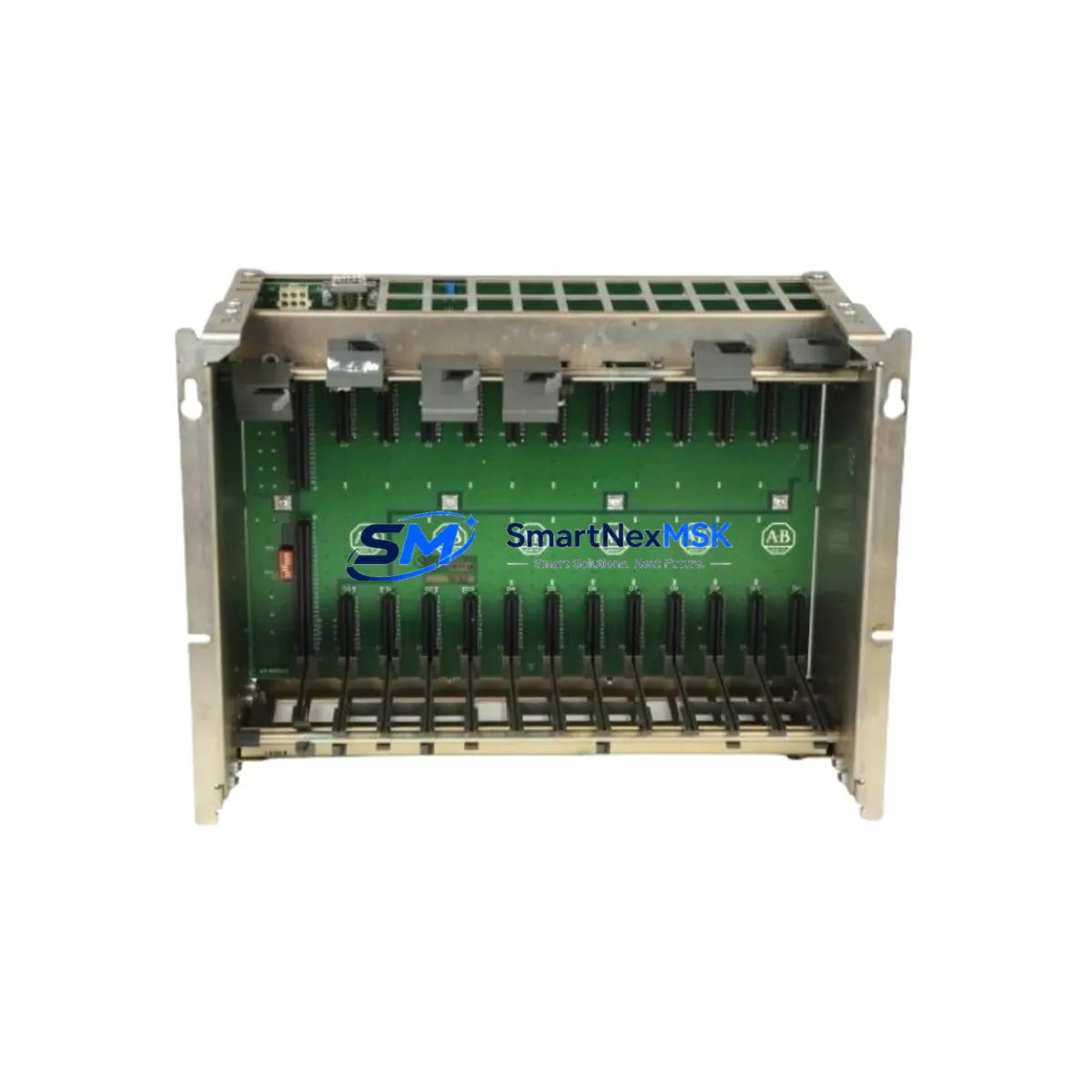
Allen-Bradley 1771-A3B/B Maintenance-Ready Spare for 1771 Automation
The Allen-Bradley 1771-A3B/B is a 12-slot I/O chassis designed for the PLC-5 programmable controller family — one of the most widely deployed control platforms in discrete manufacturing, process automation, and utilities infrastructure. As original equipment reaches end-of-life or becomes increasingly difficult to source through OEM channels, maintaining a verified spare of the 1771-A3B/B chassis is a critical element of any industrial maintenance strategy. This unit supports the full 1771 I/O module ecosystem, providing the structural and electrical backbone for field I/O, power distribution, and backplane communication within the PLC-5 control cabinet.
For maintenance engineers managing aging 1771-series control systems, the chassis is the single point of failure that can bring an entire production line to a halt. A failed backplane connector, damaged slot rail, or degraded power bus can render an otherwise functional set of I/O modules inoperable. Stocking a tested, ready-to-deploy 1771-A3B/B chassis eliminates the most critical single-point risk in PLC-5 system continuity planning.
Spare Maintenance Table
| Parameter | Specification |
|---|---|
| Part Number / SKU | 1771-A3B/B |
| Brand | Allen-Bradley (Rockwell Automation) |
| Series | PLC-5 / 1771 I/O |
| Chassis Slots | 12 I/O slots |
| Backplane Bus | 1771 parallel I/O backplane |
| Power Supply Compatibility | 1771-P4S, 1771-P6S, 1771-P7 series |
| Module Compatibility | All 1771-series I/O modules (digital, analog, specialty) |
| Mounting | Panel or rack mount, standard DIN-compatible enclosure |
| Operating Temperature | 0°C to 60°C |
| Relative Humidity | 5% to 95% non-condensing |
| Origin | United States |
| Condition | Original, tested before shipment |
| Warranty | 12 months from date of shipment |
| Typical Application | Discrete manufacturing, process control, utilities, OEM machine retrofit |
Maintenance Planning for Continuous Operation
When a 1771-A3B/B chassis is scheduled for replacement — whether during a planned outage window or in response to an unplanned fault — the replacement workflow should extend beyond the chassis itself. Experienced maintenance engineers treat a chassis swap as an opportunity to audit the entire control cabinet for latent faults and aging components that may cause the next unplanned stoppage.
Begin with the power supply. The 1771-P4S or 1771-P6S power supply module seated in the chassis should be inspected for output voltage stability, capacitor bulge, and thermal discoloration. A chassis failure is frequently preceded or accompanied by power supply degradation, and replacing the chassis without verifying the power supply risks a repeat failure within weeks. Similarly, the 1771-P7 power supply used in extended-capacity configurations should be load-tested before the system is returned to service.
Next, inspect each I/O module installed in the chassis slots. Digital input modules such as the 1771-IB and 1771-IBD, and digital output modules such as the 1771-OB and 1771-OBD, should be checked for blown fuses, damaged terminal blocks, and degraded field wiring connections. Analog I/O modules including the 1771-IF and 1771-OF series are particularly sensitive to backplane contact quality — reseat each module and verify signal integrity after chassis installation.
The 1771-ASB remote I/O adapter, if present, should be tested for communication continuity on the remote I/O link. A chassis swap that disrupts the ASB configuration can cause remote I/O faults that are difficult to diagnose without a spare adapter on hand. Likewise, any 1771-SDN DeviceNet scanner modules should be verified for network address integrity after the chassis is powered up.
Terminal blocks and field wiring connected to I/O modules should be inspected for loose terminations, insulation degradation, and corrosion — particularly in high-humidity or chemically aggressive environments. Replacing the chassis is also the right moment to verify that all fuse holders protecting output circuits are intact and that fuse ratings match the field device load specifications.
For systems using a 1785-L series PLC-5 processor, confirm that the processor module is reseated correctly in slot 0 and that the 1784-KT or 1784-KTXD communication card (if used for programming access) is functional. HMI panels connected via DH+ or DH-485 — such as PanelView 550 or PanelView 900 terminals — should be verified for communication after the chassis is restored to service. Signal isolators protecting analog loops from ground loops or noise should also be checked as part of the post-replacement commissioning sequence.
Site Replacement Workflow
The 1771-A3B/B is a direct physical and electrical replacement for earlier 1771-A3B revisions. The /B revision designation indicates a minor hardware revision that maintains full backward compatibility with all 1771-series I/O modules and PLC-5 processors. No firmware changes, address reconfiguration, or software modifications are required when substituting a /B chassis for an earlier revision in the same slot count.
Replacement procedure: (1) Document the current module slot assignments and field wiring before beginning removal. (2) De-energize the chassis via the upstream disconnect and verify zero energy with a calibrated meter. (3) Remove I/O modules in sequence, labeling each with its slot number. (4) Disconnect the power supply and remove the chassis from the panel. (5) Mount the replacement 1771-A3B/B chassis, reinstall the power supply, and reseat I/O modules in their original slot positions. (6) Restore power and verify backplane communication via the PLC-5 processor status indicators. (7) Perform a full I/O force test before returning the system to automatic operation.
This workflow minimizes downtime by eliminating guesswork during reinstallation and ensures that the replacement chassis is validated under load before production resumes. All units shipped by SMARTNEXMSK are tested prior to dispatch and include a 12-month warranty covering manufacturing defects and premature failure under normal operating conditions.
Spare Parts Support FAQ
Q: Is the 1771-A3B/B still available as a new original unit?
A: The 1771 series has been discontinued by Rockwell Automation, but original surplus stock continues to be available through authorized industrial spare parts distributors. All units supplied by SMARTNEXMSK are sourced from verified supply chains, inspected, and tested before shipment. Each unit is accompanied by documentation confirming its tested status and 12-month warranty coverage.
Q: How do I verify compatibility before ordering?
A: The 1771-A3B/B is compatible with all PLC-5 processors (1785-L series) and all 1771-series I/O modules. Confirm your existing chassis slot count (12 slots) and power supply model before ordering. If you are replacing a different slot-count chassis (such as the 1771-A2B 8-slot or 1771-A4B 16-slot), contact our technical team to confirm the correct replacement model for your application.
Q: What is included in the 12-month warranty?
A: The warranty covers manufacturing defects and premature failure under normal industrial operating conditions for 12 months from the date of shipment. It does not cover damage resulting from incorrect installation, overvoltage events, or physical damage in transit. SMARTNEXMSK provides pre-shipment test documentation for all units, which can be used to support warranty claims if required.
Q: Can SMARTNEXMSK support long-term supply for ongoing maintenance programs?
A: Yes. SMARTNEXMSK maintains inventory of 1771-series components to support planned maintenance programs, capital spares lists, and emergency replacement requirements. Contact our team to discuss volume pricing, reserved stock agreements, and lead time commitments for your facility’s ongoing PLC-5 maintenance strategy.
© 2026 SMARTNEXMSK. All rights reserved.
Original Source: https://smartnexmsk.com
Contact: [email protected] | +86 18259474341