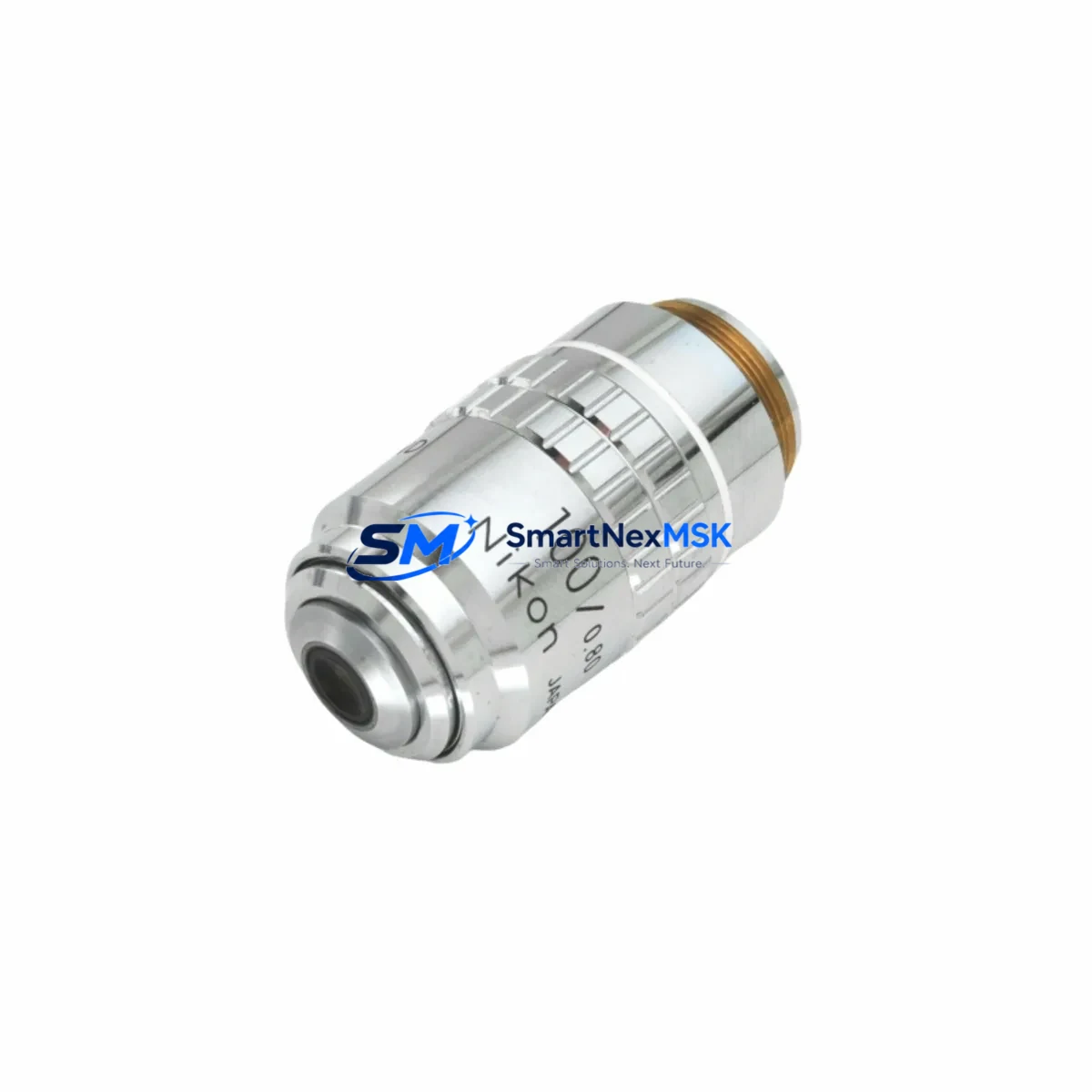
Nikon 5964C2MAFQ5KA Spare M Plan 100X ELWD Automation: Precision Spare for Industrial Inspection Systems
The Nikon 5964C2MAFQ5KA is an original M Plan series objective lens rated at 100X magnification with a 0.80 numerical aperture and Extra Long Working Distance (ELWD) design, engineered for demanding industrial inspection, semiconductor metrology, and automated optical systems. Sourced as a genuine maintenance-ready spare, this unit is tested, verified, and shipped with a 12-month warranty — ensuring your production line stays operational with minimal downtime risk.
For maintenance engineers managing automated inspection cells, wafer-handling systems, or precision measurement stations, the 5964C2MAFQ5KA represents a critical consumable in any structured spare parts program. Its compatibility with both GAS HE and GAS NF3 environments (with the companion SKU 5964C2MAGU5KA covering the NF3 configuration) makes it a versatile stocking candidate for facilities running mixed-gas inspection chambers. Holding at least one verified spare on-site eliminates the risk of extended downtime caused by lens degradation, contamination, or mechanical damage during routine maintenance cycles.
Spare Maintenance Table
| Parameter | Specification |
|---|---|
| Brand | Nikon |
| Part Number (Primary) | 5964C2MAFQ5KA |
| Companion SKU (NF3) | 5964C2MAGU5KA |
| Series | M Plan (Metallurgical Plan Apochromat) |
| Magnification | 100X |
| Numerical Aperture (NA) | 0.80 |
| Working Distance Type | ELWD (Extra Long Working Distance) |
| Tube Length | 210 / 0 (infinity-corrected) |
| Compatible Gas Environment | GAS HE (primary); GAS NF3 (5964C2MAGU5KA) |
| Product Type | Microscope Objective Lens — Industrial Inspection |
| Origin | Japan |
| Weight | 360 g |
| Application | Semiconductor metrology, wafer inspection, automated optical inspection (AOI), precision measurement |
| Mounting | Standard Nikon RMS / M Plan turret mount |
| Condition | Original spare — tested before shipment |
| Warranty | 12 Months |
Maintenance Planning for Continuous Operation
When scheduling a planned replacement of the 5964C2MAFQ5KA objective lens, a thorough inspection of the surrounding optical and mechanical system is essential to prevent repeat failures and maximize uptime. Maintenance engineers should treat this lens swap as an opportunity for a full inspection-station audit.
Begin by verifying the condition of the objective turret assembly and its locking mechanism — worn detents or contaminated threads can cause misalignment that damages a new lens within days of installation. Inspect the coarse and fine focus drive for backlash or stiction, as these directly affect the working distance repeatability that the ELWD design depends on.
Check the illumination light source module (typically a halogen or LED ring illuminator or coaxial epi-illuminator) for output consistency; a degraded light source will mask optical performance issues and lead to premature lens replacement cycles. Verify the beam splitter or half-mirror cube for delamination or coating degradation, particularly in GAS HE environments where trace moisture can accelerate coating failure.
For systems operating in controlled gas environments, inspect the gas purge inlet fittings, flow regulators, and chamber seals to confirm the GAS HE or GAS NF3 atmosphere is maintained at specification. A compromised seal is a leading cause of lens contamination and premature optical degradation. If the system uses a CCD or CMOS camera module mounted to the trinocular port, verify the C-mount adapter and sensor window are clean and free of particulate — contamination at the sensor propagates apparent image defects that are often misattributed to the objective lens.
Review the stage controller and XY positioning encoder for drift or lost steps, which can cause the objective to contact the sample surface — a common cause of ELWD lens damage in automated systems. Confirm that the Z-axis limit switches and soft-stop parameters in the motion controller are correctly configured for the 100X ELWD working distance. Also inspect the anti-vibration isolation table or active damping system; degraded isolators introduce vibration that reduces effective resolution and accelerates mechanical wear on the objective mount.
Finally, cross-reference your spare parts inventory to ensure you hold at least one additional unit of the 5964C2MAFQ5KA (or 5964C2MAGU5KA for NF3 systems), along with spare objective lens cleaning supplies, immersion oil (if applicable), and turret O-rings. A well-structured spare parts kit for this inspection station should also include a backup illumination module, stage encoder read head, and camera interface cable to cover the most common failure modes in a single maintenance event.
Site Replacement Workflow
Replacing the 5964C2MAFQ5KA in the field follows a structured sequence to minimize downtime and ensure system compatibility is maintained from the first power-on after installation.
Step 1 — Isolation: Power down the inspection system and engage the gas purge bypass if operating in a GAS HE or NF3 environment. Allow the chamber to vent to ambient before opening the objective access port.
Step 2 — Removal: Rotate the turret to the 100X position. Using a lens spanner or gloved hands, unthread the 5964C2MAFQ5KA counterclockwise. Inspect the turret thread for contamination or damage before installing the replacement unit.
Step 3 — Installation: Thread the new 5964C2MAFQ5KA clockwise until finger-tight, then apply a quarter-turn with a lens spanner. Do not overtighten. Confirm the lens seats flush against the turret shoulder.
Step 4 — System Verification: Restore gas flow, power up the system, and perform a focus calibration routine using a certified reference target (e.g., NIST-traceable chrome-on-glass resolution target). Verify that the working distance, parfocality offset, and image center are within specification before returning the station to production.
Step 5 — Documentation: Record the replacement in the equipment maintenance log, including the new lens serial number, installation date, and post-installation calibration results. Update the spare parts inventory to trigger a reorder of the consumed unit.
This workflow applies equally when upgrading from an older or discontinued Nikon M Plan objective to the current 5964C2MAFQ5KA, ensuring backward compatibility with existing Nikon-standard turret mounts and control software without requiring mechanical modifications to the inspection station.
Spare Parts Support FAQ
Q1: What is the expected service life of the Nikon 5964C2MAFQ5KA, and when should I plan a replacement?
Service life depends heavily on operating environment and handling frequency. In a clean, controlled GAS HE environment with automated sample handling, the lens may operate for several years without degradation. In manually operated or higher-contamination environments, annual inspection is recommended. Plan a replacement when image contrast drops, resolution targets fail acceptance criteria, or physical damage (scratches, coating delamination, thread wear) is observed during routine inspection.
Q2: How do I verify compatibility before installing the 5964C2MAFQ5KA on my existing Nikon inspection system?
Confirm that your system uses a standard Nikon M Plan turret mount and is configured for infinity-corrected (210/0) optics. Verify the gas environment matches the GAS HE specification of the 5964C2MAFQ5KA — if your system uses NF3, order the companion SKU 5964C2MAGU5KA instead. Check the system’s Z-axis travel range to confirm it accommodates the ELWD working distance at 100X.
Q3: What pre-shipment testing is performed on this spare unit?
Each 5964C2MAFQ5KA unit is inspected for optical clarity, coating integrity, and thread condition prior to shipment. Functional verification is performed against a reference target to confirm resolution and contrast performance. Units that do not meet acceptance criteria are not shipped. All units are covered by a 12-month warranty from the date of delivery.
Q4: Can I stock this part for long-term inventory, and what are the storage requirements?
Yes. The 5964C2MAFQ5KA is well-suited for long-term spare parts inventory. Store in the original packaging or a sealed, padded lens case in a clean, dry environment at 15–25°C with relative humidity below 60%. Avoid storage near solvents, acids, or strong magnetic fields. Inspect stored units annually for fungal growth or coating degradation. Long-term supply availability is supported — contact us for volume stocking arrangements.
© 2026 SMARTNEXMSK. All rights reserved.
Original Source: https://smartnexmsk.com
Contact: [email protected] | +86 18259474341