
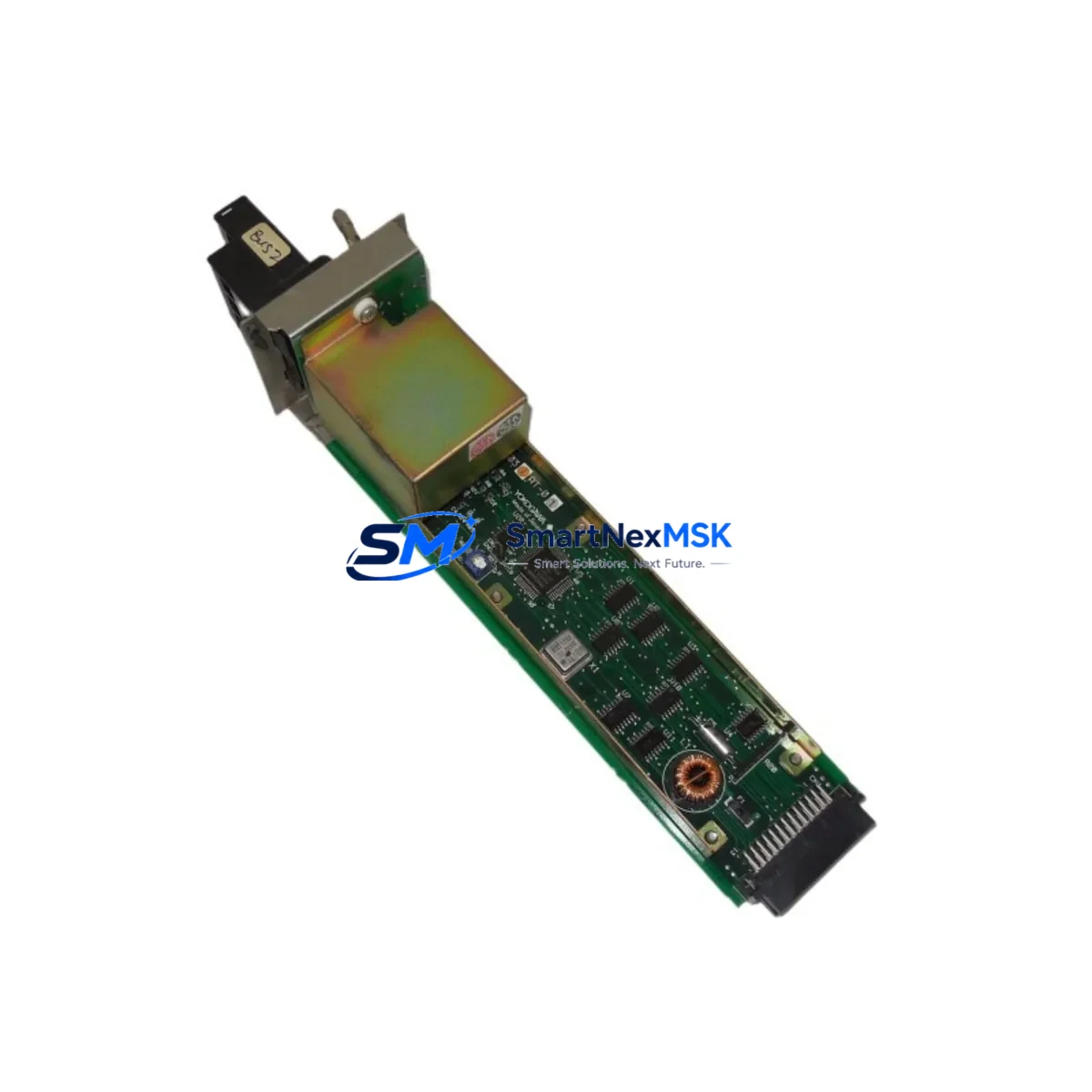
YOKOGAWA AIP512 Maintenance-Ready Spare for CENTUM VP Automation
The YOKOGAWA AIP512 is an original RIO (Remote I/O) Bus Connection Module designed for CENTUM VP and CENTUM CS 3000 Distributed Control Systems. As a critical communication backbone component, the AIP512 manages the high-speed serial data link between the Field Control Station (FCS) and Remote I/O units deployed across the plant floor. For maintenance engineers managing aging DCS infrastructure, securing a tested and verified AIP512 spare is a foundational step in any downtime-prevention strategy.
When a CENTUM VP system experiences RIO bus communication faults — manifesting as I/O dropout alarms, FCS-to-RIO link failures, or intermittent signal loss — the AIP512 is among the first modules to inspect and replace. Its role in sustaining continuous process control makes it a high-priority item on any spare parts list for facilities running YOKOGAWA-based automation architectures.
Each AIP512 unit shipped by SMARTNEXMSK is sourced from verified supply channels, subjected to functional testing prior to dispatch, and covered by a 12-month warranty. We maintain long-term stock to support both emergency replacement and planned maintenance cycles.
Spare Maintenance Table
| SKU / Part Number | AIP512 |
| Brand | YOKOGAWA |
| Compatible Systems | CENTUM VP, CENTUM CS 3000 |
| Module Function | RIO Bus Connection Module — links FCS to Remote I/O units via high-speed serial bus |
| Module Type | DCS Communication / Bus Interface Module |
| Installation Location | Field Control Station (FCS) node unit or RIO node cabinet |
| Bus Protocol | YOKOGAWA proprietary RIO Bus (high-speed serial) |
| Operating Environment | Industrial control cabinet; standard DCS operating conditions |
| Country of Origin | Japan |
| Weight | Approx. 300 g |
| Compatibility Verification | Confirm FCS firmware version and RIO node configuration before installation |
| Maintenance Recommendation | Inspect bus connectors, check LED status indicators, verify RIO link diagnostics via CENTUM VP Engineering Environment |
| Warranty | 12 Months — functional warranty covering communication performance and hardware integrity |
| Pre-Shipment Testing | Yes — each unit tested before dispatch |
Maintenance Planning for Continuous Operation
Replacing the AIP512 in a live CENTUM VP environment is rarely an isolated task. Experienced maintenance engineers know that a RIO bus fault often signals stress across multiple interconnected components. During any planned or emergency replacement of the AIP512, the following associated modules and components should be inspected or held as co-spares:
The AIP511 (RIO Bus Connection Module, alternate variant) shares the same bus architecture and should be cross-checked if dual-redundant RIO configurations are in use. The ACM12 communication module governs higher-level network connectivity within the FCS and may exhibit related faults if bus integrity is compromised. Power supply modules such as the PW481 or PW482 should be verified for stable output voltage, as undervoltage conditions are a common root cause of intermittent RIO bus errors.
On the I/O side, AAI141 analog input modules and ADV151 digital output modules connected downstream of the RIO bus should be functionally tested after any bus module replacement to confirm signal integrity. Terminal blocks and field wiring connectors within the RIO node cabinet should be inspected for corrosion, loose terminations, or insulation degradation — particularly in high-humidity or high-vibration environments.
For facilities running CENTUM CS 3000 legacy systems, the CP451 or CP461 Field Control Processors may require a soft restart after AIP512 replacement to re-establish RIO bus synchronization. Communication modules handling HART pass-through or FOUNDATION Fieldbus segments — such as the ALF111 — should also be checked if field device communication is affected post-replacement.
Where HMI connectivity is involved, verifying the HIS (Human Interface Station) alarm logs and trend data continuity after bus restoration is recommended. Signal isolators and surge protection devices installed on RIO cable runs should be inspected as part of the same maintenance window to prevent recurrence.
Maintaining a minimum of one AIP512 unit in your on-site spare parts inventory — alongside matched power supply and I/O module spares — is the most effective strategy for minimizing unplanned downtime in CENTUM VP-based process control environments.
Site Replacement Workflow
Step 1 — Pre-Replacement Verification: Access the CENTUM VP Engineering Environment and document the current RIO bus configuration, node addresses, and FCS link status. Capture any active alarms related to RIO communication faults. Confirm the AIP512 replacement unit’s part number and hardware revision match the installed module.
Step 2 — Safe Isolation: Follow your site’s lockout/tagout (LOTO) procedure for the affected FCS or RIO node cabinet. If the system supports hot-swap or online replacement, confirm this capability in the FCS hardware manual before proceeding without a full shutdown.
Step 3 — Module Removal and Installation: Remove the faulty AIP512 by releasing the module locking mechanism and carefully disconnecting the bus connector. Insert the replacement AIP512, ensuring the bus connector is fully seated and the module locking tab is engaged. Verify LED status indicators illuminate correctly upon power restoration.
Step 4 — System Restoration and Verification: Re-establish RIO bus communication via the Engineering Environment. Confirm all downstream I/O nodes report online status. Verify analog and digital signal values against field instrumentation readings. Clear resolved alarms and document the replacement in the site maintenance log.
Step 5 — Post-Replacement Monitoring: Monitor RIO bus diagnostic data for a minimum of 24 hours post-replacement to confirm stable communication. Schedule a follow-up inspection of associated power supply and I/O modules within the next planned maintenance window.
This workflow applies equally to CENTUM CS 3000 installations. For older systems where the AIP512 has been discontinued by the OEM, SMARTNEXMSK maintains long-term stock to support extended system life and deferred migration timelines.
Spare Parts Support FAQ
Q1: Is the AIP512 compatible with both CENTUM VP and CENTUM CS 3000?
Yes. The AIP512 RIO Bus Connection Module is designed for use across CENTUM VP and CENTUM CS 3000 DCS platforms. Before installation, verify the hardware revision and firmware compatibility with your specific FCS version using the YOKOGAWA hardware compatibility matrix or by consulting your system documentation.
Q2: What testing is performed before the AIP512 is shipped?
Each AIP512 unit undergoes functional testing prior to dispatch to verify bus communication performance and hardware integrity. Units are inspected for physical condition, connector integrity, and correct LED response. A 12-month warranty is provided covering functional performance from the date of receipt.
Q3: How should the AIP512 be stored as a long-term spare?
Store the AIP512 in its original anti-static packaging in a dry, temperature-controlled environment away from direct sunlight and electromagnetic interference sources. Recommended storage conditions follow standard IEC 60068 guidelines for electronic components. Inspect stored units annually and rotate stock to ensure readiness.
Q4: Can SMARTNEXMSK support ongoing spare parts supply for CENTUM VP and CS 3000 systems?
Yes. SMARTNEXMSK maintains long-term inventory of YOKOGAWA DCS spare parts including RIO bus modules, power supplies, I/O modules, and communication components. We support both emergency single-unit orders and bulk procurement for planned maintenance programs. Contact our team to discuss a tailored spare parts supply agreement for your facility.
© 2026 SMARTNEXMSK. All rights reserved.
Original Source: https://smartnexmsk.com
Contact: [email protected] | +86 18259474341



