
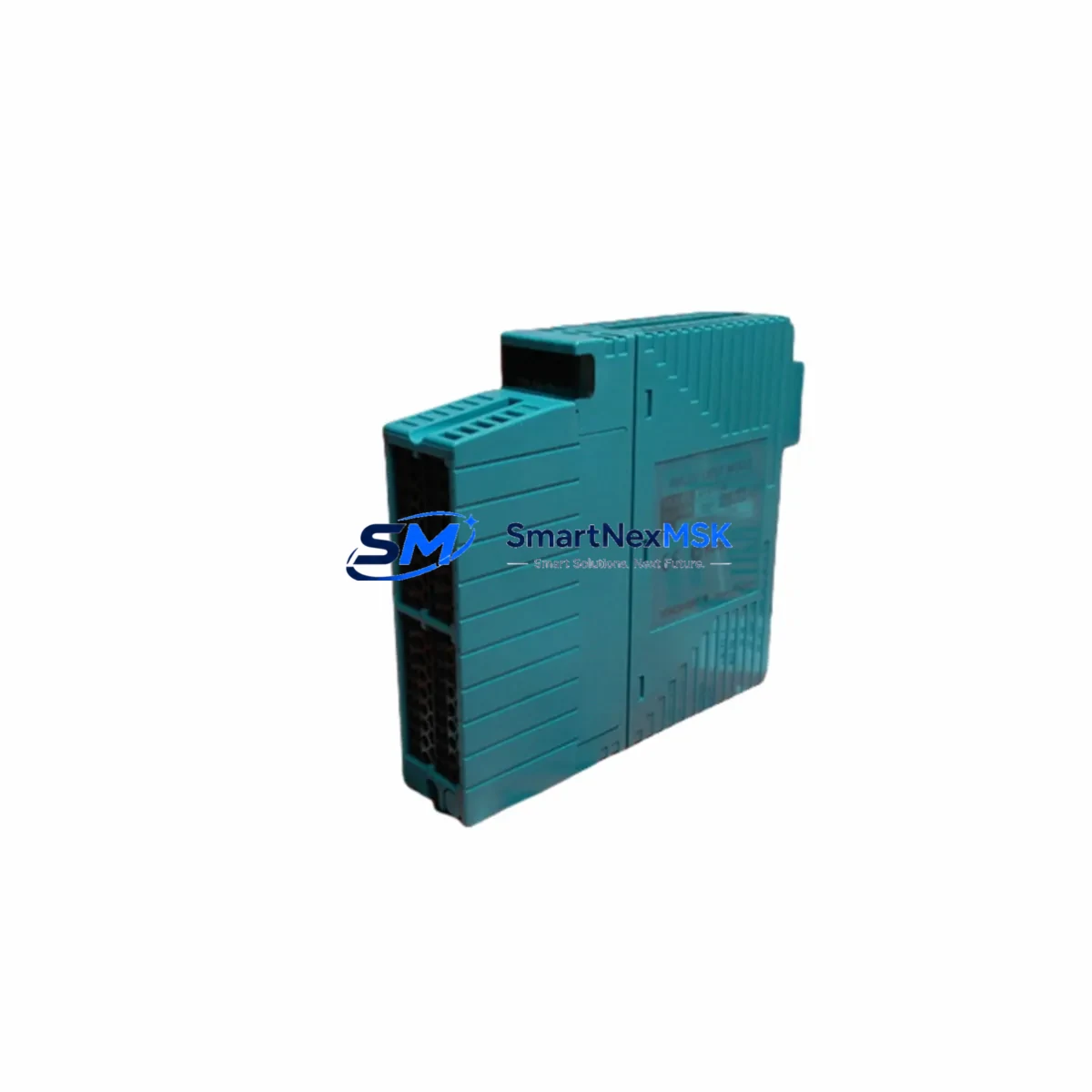
YOKOGAWA NFAI135-S51 Retrofit-Ready Analog Input for CENTUM VP CS 3000: Compatible Modernization & Smooth System Upgrade
The YOKOGAWA NFAI135-S51 is a 16-channel analog input module engineered for the CENTUM VP and CS 3000 distributed control system (DCS) platforms. As legacy CENTUM CS 3000 installations reach end-of-life and spare parts become increasingly scarce, the NFAI135-S51 serves as a verified retrofit-ready replacement that enables control engineers to restore full I/O capacity, maintain process continuity, and extend the operational life of existing control cabinets without committing to a full platform migration.
This module accepts 4–20 mA analog signals across 16 independent input channels, with each channel supporting HART communication for field device diagnostics. It mounts directly onto the CENTUM VP field control unit (FCU) node unit backplane, sharing the same mechanical footprint and terminal block wiring layout as the discontinued NFAI135 variants. For sites running mixed CENTUM CS 3000 and CENTUM VP architectures, the NFAI135-S51 provides a single-module solution that bridges both generations without requiring backplane replacement or FCU reconfiguration.
Upgrade Compatibility Table
| Parameter | NFAI135-S51 (This Module) | Legacy / Replaced Models |
|---|---|---|
| Input Channels | 16-ch analog input (4–20 mA) | NFAI135, NFAI135-S00 |
| HART Support | Yes (per channel) | Varies by revision |
| Backplane Interface | CENTUM VP / CS 3000 node unit backplane | Direct drop-in compatible |
| Installation | Slide-in module, no tools required | Same form factor |
| Communication | Vnet/IP (CENTUM VP), ESB (CS 3000) | Protocol-compatible |
| Replacement Recommendation | Direct replacement for NFAI135 series | Verify S-suffix revision |
| Commissioning Notes | Module address auto-assigned via FCU; verify in System View | Manual address check required on CS 3000 |
| Warranty | 12-Month Warranty — Covered from date of shipment | |
Retrofit Planning for Existing Automation Systems
Successful integration of the NFAI135-S51 into a running plant begins well before the module arrives on site. Engineers should start by auditing the existing FCU node unit to confirm available backplane slots and verify that the power supply module — typically an NFPS100 or NFPS200 series unit — can support the additional load of the replacement analog input card. Power budget calculations should account for all co-installed modules in the same node unit, including any NFDO series digital output modules, NFAI or NFBI analog input cards, and communication interface modules such as the ALF111 or ALR121 Vnet/IP link modules.
Terminal block wiring is a critical checkpoint. The NFAI135-S51 uses the same 40-pin terminal block connector as earlier NFAI135 variants, meaning field wiring from existing junction boxes can typically be reconnected without re-termination. However, engineers should inspect each channel’s shielding continuity and verify that the field-side 24 VDC loop power supply — often sourced from an NTBAS or external DIN-rail PSU — is within specification before energizing the new module.
On the software side, the CENTUM VP engineering environment (System View / Control Drawing Builder) will automatically detect the NFAI135-S51 upon insertion if the FCU is online. For CS 3000 systems, the module must be registered manually in the Station Builder before downloading the revised IOM (I/O Module) definition to the FCU. Engineers should export and archive the existing control drawing (CD) and function block (FB) assignments before any download to protect original program logic. HMI faceplates linked to the replaced module’s tag addresses will continue to function without modification, provided the new module occupies the same slot address as its predecessor.
Where slot addresses differ — for example, when consolidating I/O from a decommissioned node unit into a surviving FCU — engineers must update the I/O assignment table in the engineering database and perform a full consistency check before downloading. This process also applies when migrating from a CS 3000 FCS (Field Control Station) to a CENTUM VP FCU, where the communication protocol transitions from ESB bus to Vnet/IP. In such cases, the NFAI135-S51 can be pre-configured offline using the CENTUM VP engineering PC and a portable programming cable before being installed in the target cabinet.
Downtime Control During System Migration
Minimizing unplanned downtime during an analog input module replacement requires a structured hot-swap or cold-swap strategy depending on the FCU’s redundancy configuration. For redundant FCU pairs, the NFAI135-S51 can be installed in the standby FCU first, verified online, and then switched to active status — keeping the process running throughout. For simplex (non-redundant) FCUs, the replacement window should be coordinated with operations to align with scheduled maintenance shutdowns or low-demand production periods.
Before pulling the legacy module, engineers should place all affected control loops in manual mode at the CENTUM VP HIS (Human Interface Station) operator console. This prevents runaway outputs on downstream NFDO digital output modules or NFAO analog output modules that may be responding to the now-interrupted input signals. Once the NFAI135-S51 is seated and the FCU has completed its self-diagnostic cycle — typically within 30 seconds — input channels can be verified against field transmitter readings before returning loops to automatic control.
All replacement modules supplied by SMARTNEXMSK are pre-tested against YOKOGAWA factory acceptance criteria and shipped with a 12-month warranty covering manufacturing defects and functional failures. Each unit is inspected for firmware revision compatibility and labeled with the verified S-suffix designation to eliminate on-site revision mismatches.
Retrofit Support FAQ
Q1: Is the NFAI135-S51 a direct drop-in replacement for the NFAI135-S00?
A: In most installations, yes. Both modules share the same backplane connector, terminal block pinout, and channel count. The S51 suffix indicates a hardware revision with enhanced HART pass-through capability. Verify the FCU firmware version supports the S51 revision; CENTUM VP R5.03 and later are fully compatible. CS 3000 R3.09 and later also support the S51 variant with a Station Builder update.
Q2: Do I need to re-download the control program after replacing the module?
A: For CENTUM VP systems with the module in the same slot, no program download is required — the FCU re-initializes the module automatically. For CS 3000 systems or when the slot address changes, a partial download of the IOM definition is required. Full CD download is only necessary if tag assignments or FB connections have been modified.
Q3: How do I verify wiring and channel integrity before returning loops to auto?
A: Use the CENTUM VP System View I/O Monitor to check each channel’s raw input value against the field transmitter’s local indicator. For HART-enabled transmitters, initiate a HART communication test from the engineering console to confirm device identity and PV reading. Any channel showing an open-circuit or out-of-range alarm should be inspected at the terminal block and field junction box before loop transfer.
Q4: What warranty and post-shipment support does SMARTNEXMSK provide?
A: Every NFAI135-S51 unit ships with a 12-month warranty from the date of delivery. Warranty coverage includes functional failures, firmware incompatibility identified at commissioning, and DOA (dead-on-arrival) replacements. Our technical team can provide pre-shipment test reports, revision confirmation, and remote commissioning guidance. Contact us at [email protected] or +86 18259474341 for retrofit planning support.
© 2026 SMARTNEXMSK. All rights reserved.
Original Source: https://smartnexmsk.com
Contact: [email protected] | +86 18259474341



