
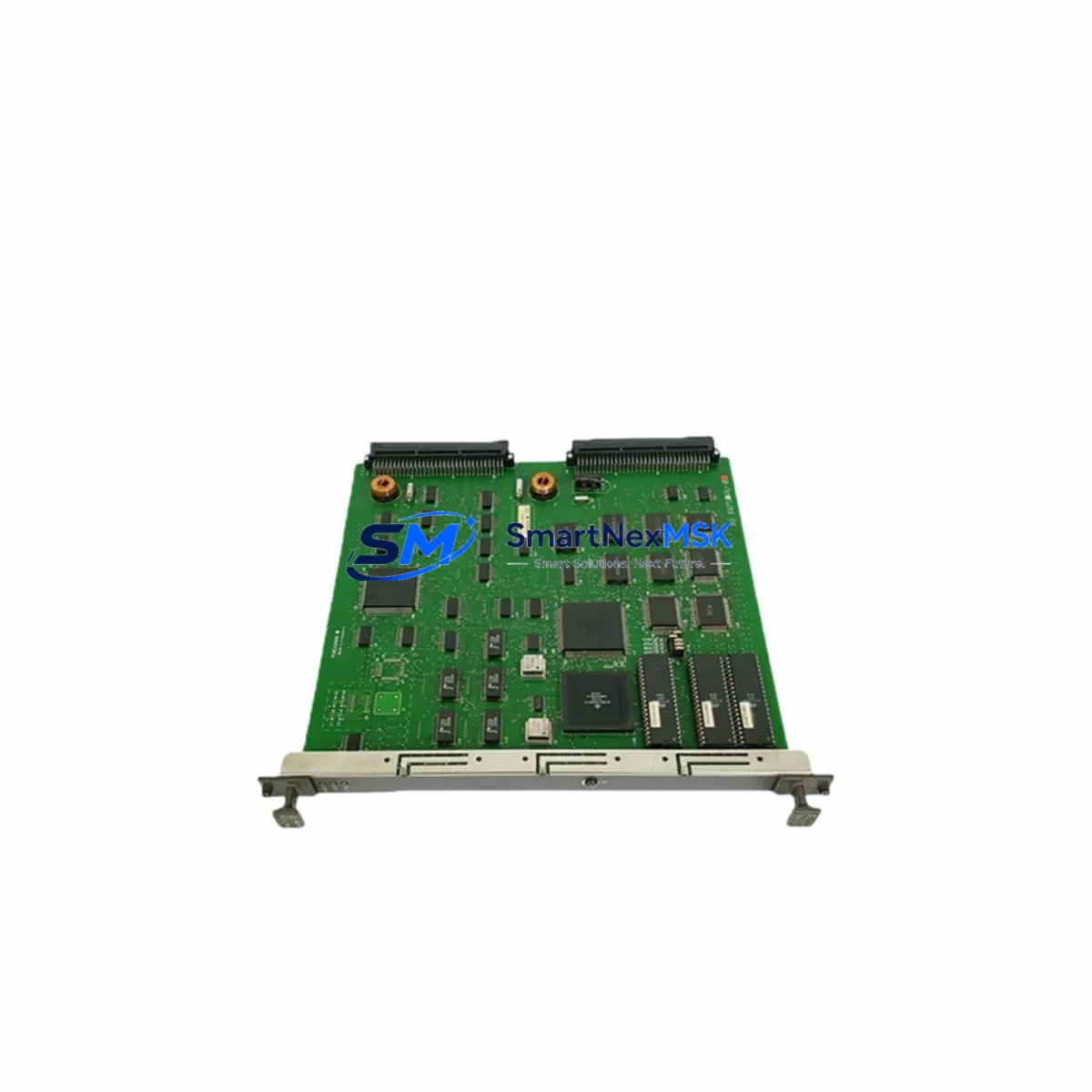
YOKOGAWA RB301 S2 Retrofit-Ready RIO Bus Master for CENTUM CS3000 Control Systems
The YOKOGAWA RB301 S2 is a RIO (Remote I/O) Bus Master Card engineered for seamless integration into YOKOGAWA CENTUM CS, CENTUM CS3000, and CENTUM VP distributed control systems. As legacy DCS installations age and original spare parts become increasingly scarce, the RB301 S2 has emerged as the go-to retrofit solution for plant engineers managing aging control infrastructure. Whether you are replacing a failed card in an active production line, upgrading a CENTUM CS system to extend its operational life, or executing a phased migration toward CENTUM VP architecture, the RB301 S2 delivers the compatibility, reliability, and verified performance that industrial facilities demand.
Sourced directly from authorized channels and subjected to full functional verification prior to shipment, every RB301 S2 unit supplied by SMARTNEXMSK is backed by a 12-month warranty. Our inventory is maintained to support urgent replacement scenarios, minimizing unplanned downtime for process-critical operations in oil and gas, petrochemical, power generation, and advanced manufacturing environments.
Upgrade Compatibility Table
| Parameter | Details |
|---|---|
| SKU | RB301 S2 |
| Brand | YOKOGAWA |
| Compatible Systems | CENTUM CS, CENTUM CS3000, CENTUM VP |
| Module Function | RIO Bus Master Card – manages Remote I/O communication between FCS and RIO nodes |
| Bus Interface | RIO Bus (YOKOGAWA proprietary high-speed serial bus) |
| Installation Slot | FCS (Field Control Station) backplane – compatible with AFV10S, AFV30S, and equivalent FCS units |
| Power Requirement | Supplied via FCS backplane; verify backplane power budget before installation |
| Communication Compatibility | RIO Bus protocol; compatible with EB401, EB501 RIO node units |
| Replacement Recommendation | Direct drop-in replacement for failed or end-of-life RB301 S2 in existing FCS racks |
| Commissioning Notes | Module address must be confirmed in CENTUM Engineering Environment (CEW) before hot insertion; verify I/O map and tag assignments post-swap |
| Origin | Japan |
| Warranty | 12 Months – covers manufacturing defects and functional failure under normal operating conditions |
| Shipping | Global express shipping available; ESD-safe packaging; export documentation provided |
Retrofit Planning for Existing Automation Systems
Retrofitting a CENTUM CS or CS3000 system requires careful coordination across multiple hardware layers. The RB301 S2 sits at the heart of the RIO communication architecture, acting as the bus master that orchestrates data exchange between the Field Control Station and distributed Remote I/O nodes. Before initiating a replacement, engineers must audit the existing FCS rack configuration, confirming that the AFV10S or AFV30S Field Control Station backplane has sufficient available slots and that the power supply module — typically an APW11S or APW12S power supply unit — can sustain the additional load introduced by the replacement card.
On the RIO node side, the RB301 S2 communicates with EB401 or EB501 Remote I/O node units, which in turn host analog input modules such as the AAI141 or AAI143, analog output modules like the AAO141, and digital I/O modules including the ADV151 and ADV161. Any change to the bus master card requires verification that all downstream node addresses remain consistent with the configuration stored in the CENTUM Engineering Environment. Mismatched node addresses are among the most common causes of post-retrofit communication faults and must be resolved before returning the system to automatic control.
For plants running CENTUM CS3000 with Vnet/IP communication infrastructure, the RB301 S2 retrofit is typically part of a broader upgrade that may also involve replacing aging CP451 or CP461 controller processors and updating the HIS (Human Interface Station) software to ensure HMI screen compatibility with the refreshed I/O map. Engineers should export and archive all existing tag databases, loop diagrams, and function block configurations from the CENTUM Engineering Environment before beginning any hardware swap. This archive serves as the recovery baseline if commissioning reveals unexpected discrepancies between the new module’s behavior and the legacy program logic.
Terminal wiring on the RIO bus cable — typically a shielded twisted-pair running between the FCS and each EB401/EB501 node — should be inspected for insulation degradation, connector corrosion, and proper termination resistance. In older CENTUM CS installations, the RIO bus cable may have been installed for 15 or more years, and its condition directly affects the reliability of the upgraded bus master. SMARTNEXMSK recommends performing a full cable continuity and insulation resistance test as part of the retrofit planning process, independent of the RB301 S2 card replacement itself.
Downtime Control During System Migration
Minimizing unplanned downtime is the primary operational concern when replacing a RIO Bus Master Card in a live DCS environment. The RB301 S2 supports a structured hot-swap procedure within CENTUM CS3000 and CENTUM VP systems, provided the FCS is configured for redundant operation. In redundant FCS configurations, the standby controller can assume full bus master responsibility while the primary RB301 S2 is removed and replaced, allowing the field I/O — including all connected analog and digital modules — to remain in service throughout the swap.
For non-redundant FCS installations, a controlled shutdown window must be planned. The recommended approach is to place all regulatory control loops in manual mode at the HIS operator station, confirm that all field devices are in a safe hold state, and then proceed with the card replacement. After installing the new RB301 S2, the commissioning sequence should begin with a bus communication diagnostic from the CENTUM Engineering Environment, verifying that all RIO nodes — including every EB401 and EB501 unit on the bus — are recognized and reporting correct I/O status before any loop is returned to automatic control.
SMARTNEXMSK ships all RB301 S2 units with full pre-shipment functional testing documentation, reducing the risk of receiving a non-functional card and eliminating one of the most common causes of extended retrofit downtime. Our standard lead time for in-stock units is 3–5 business days for international express delivery, with expedited same-day dispatch available for urgent plant recovery scenarios. All units are shipped in ESD-safe anti-static packaging with humidity indicator cards to protect sensitive bus interface circuitry during transit.
Retrofit Support FAQ
Q1: Is the RB301 S2 a direct replacement for the original YOKOGAWA RB301 S2 installed in my CENTUM CS system?
Yes. The RB301 S2 supplied by SMARTNEXMSK is the identical OEM part number and is a direct drop-in replacement for the original module. No firmware modification or hardware adaptation is required. The replacement card will be recognized by the CENTUM Engineering Environment using the same module type designation as the original, preserving all existing I/O tag assignments and function block references.
Q2: What commissioning steps are required after installing the replacement RB301 S2?
After physical installation, connect to the CENTUM Engineering Environment and perform a module recognition scan on the FCS. Confirm that all RIO node addresses (EB401/EB501 units) are correctly enumerated and that I/O status for all connected analog and digital modules is normal. Place the FCS in online mode and verify that all control loops are receiving correct process variable values before returning any loop to automatic. Document the post-commissioning I/O scan results for your maintenance records.
Q3: How do I verify wiring compatibility before installing the RB301 S2?
The RB301 S2 connects to the FCS backplane via the standard YOKOGAWA module slot connector — no external field wiring is terminated directly on the card. The RIO bus cable connects at the FCS backplane level, not at the module itself. Verify that the backplane slot is clean, that the bus cable termination resistors are correctly installed at both ends of the RIO bus, and that the cable shield is properly grounded at the FCS end. Refer to the CENTUM CS3000 Hardware Manual (IM 33S01B30-01E) for detailed backplane wiring specifications.
Q4: What does the 12-month warranty cover, and what is the return process?
The 12-month warranty covers all manufacturing defects and functional failures under normal operating conditions, including RIO bus communication faults, backplane interface failures, and module recognition errors attributable to the card itself. Warranty claims are initiated by contacting SMARTNEXMSK at [email protected] with your order reference and a description of the fault. We will arrange return shipping and provide a replacement or full refund within 10 business days of receiving the returned unit. Damage caused by incorrect installation, overvoltage, or physical impact is not covered under the standard warranty.
© 2026 SMARTNEXMSK. All rights reserved.
Original Source: https://smartnexmsk.com
Contact: [email protected] | +86 18259474341



