
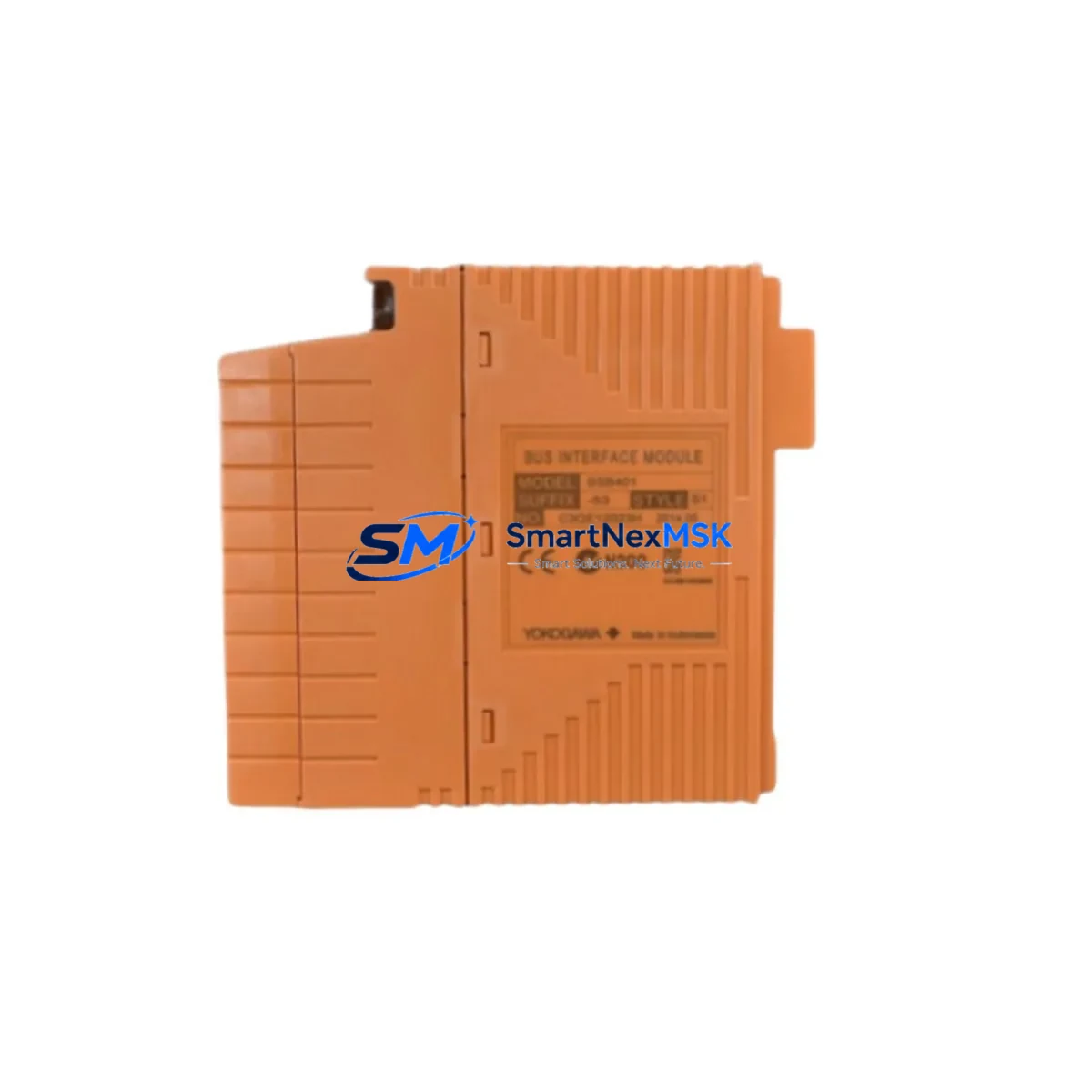
YOKOGAWA SSB401-13 Retrofit-Ready Interface for STARDOM FCN Control Systems
The YOKOGAWA SSB401-13 is a Slave Station Bus (SSB) interface module engineered for the STARDOM FCN and FCJ distributed control platform. As legacy STARDOM installations age and original spare parts become increasingly scarce, the SSB401-13 has emerged as a critical retrofit component for engineers tasked with sustaining, modernizing, or migrating aging automation infrastructure. Whether you are replacing a failed unit in a running plant, upgrading a control cabinet to extend its operational life, or migrating from an older YOKOGAWA STARDOM architecture to a more current configuration, the SSB401-13 provides the electrical and protocol compatibility required for a smooth, low-risk transition.
Our inventory of the SSB401-13 is sourced from verified industrial channels, subjected to incoming inspection, and backed by a 12-month warranty covering functional defects under normal operating conditions. Each unit is tested for bus communication integrity before dispatch, ensuring that what arrives on-site is ready for installation without additional bench verification delays.
Upgrade Compatibility Table
| Parameter | SSB401-13 Specification | Retrofit Notes |
|---|---|---|
| Compatible Platform | STARDOM FCN / FCJ | Verify FCN-100 or FCN-500 chassis generation before ordering |
| Bus Interface | Slave Station Bus (SSB) | Confirm backplane slot assignment matches original module address |
| Communication Protocol | STARDOM internal SSB protocol | No protocol reconfiguration required for direct replacement |
| Power Supply Requirement | Supplied via backplane (no external wiring) | Verify PSU-101 or PSU-201 power module capacity before hot-swap |
| Terminal / Connector | Backplane edge connector | No field wiring changes required; confirm slot keying |
| Module Address | Configured via FCN engineering tool | Re-use original address from project backup; no re-addressing needed for 1:1 swap |
| Program Compatibility | Fully compatible with existing FCN IEC 61131-3 application | No POU modification required; validate I/O mapping post-installation |
| HMI Integration | Transparent to SCADA / HMI layer | CENTUM VP or third-party OPC-DA/UA tags remain unchanged |
| Installation Format | Rack-mount, DIN-rail chassis | Fits standard FCN base unit; no mechanical modification |
| Warranty | 12 Months | Covers functional defects; includes pre-shipment communication test |
Retrofit Planning for Existing Automation Systems
A successful SSB401-13 retrofit begins well before the module arrives on-site. Engineers should pull the current FCN project archive from the engineering workstation and confirm the slot topology of the affected base unit. The FCN base unit — whether a compact FCN-100 or a larger FCN-500 chassis — houses the CPU module, power supply module, and a defined number of I/O and communication slots. The SSB401-13 occupies one of these slots as the slave bus interface, bridging the CPU to downstream I/O expansion racks or remote I/O nodes.
Before removing the legacy module, document the following: the physical slot number, the module address as shown in the FCN engineering tool, and the current firmware revision of the CPU module (typically an FCN-CPU or FCJ-CPU variant). Cross-reference this against the SSB401-13 hardware revision to confirm compatibility. In most FCN installations, the SSB401-13 is paired with remote I/O racks populated with analog input modules such as the AAI141-S or AAI543-H, digital output modules such as the ADO141-P, and thermocouple input modules such as the AAT141-S. These downstream modules communicate over the slave bus and will resume normal operation immediately after the SSB401-13 is replaced, provided the module address is preserved.
For installations that also include a communication module such as the ALR121-S for HART pass-through or the ALE111 for Ethernet-based field device integration, verify that the SSB bus load budget is within specification after the swap. Power supply modules — particularly the PSU-101 or PSU-201 — should be checked for available headroom, as aging power supplies in long-running installations may be operating near their rated output. If the control cabinet also houses a YOKOGAWA FieldMate handheld or a dedicated programming cable for FCN configuration, ensure these tools are available on-site for post-installation validation.
For sites migrating from an older STARDOM FCN generation to a newer FCN-RTU or hybrid CENTUM VP architecture, the SSB401-13 can serve as an interim interface module, maintaining continuity of the existing I/O infrastructure while the migration is staged over multiple planned outage windows. This approach avoids the cost and risk of a full cutover and allows the control narrative, alarm philosophy, and HMI faceplates to be validated incrementally.
Downtime Control During System Migration
Minimizing unplanned downtime is the primary concern for any plant engineer authorizing a module swap on a live control system. For the SSB401-13, the replacement procedure is straightforward when the system is in a safe state: power down the affected FCN base unit following the YOKOGAWA-recommended de-energization sequence, extract the failed module, insert the replacement SSB401-13 into the same slot, restore power, and confirm bus communication status via the FCN status LEDs and the engineering tool’s online diagnostics view.
Where a cold swap is not operationally acceptable, some FCN configurations support partial rack isolation, allowing the affected slave bus segment to be taken offline while adjacent I/O segments remain in service. This requires careful review of the FCN project’s I/O assignment and the plant’s safety instrumented system (SIS) boundaries. In all cases, the original application program — stored on the FCN CPU’s non-volatile memory — is preserved through the module swap and does not require re-download unless the engineering team elects to push a revised project version simultaneously.
Post-installation, the recommended validation sequence includes: confirming all slave bus nodes are online in the FCN engineering tool, verifying analog input readings against field transmitter values, checking digital output states against the DCS or SCADA faceplate, and reviewing the FCN event log for any bus error or communication fault entries. This sequence typically takes 15–30 minutes for an experienced commissioning engineer and can be completed within a single planned maintenance window, keeping total controlled downtime well under two hours for a standard single-module replacement.
Retrofit Support FAQ
Q1: Is the SSB401-13 a direct drop-in replacement for the original YOKOGAWA STARDOM FCN slave bus module?
Yes. The SSB401-13 is designed as a direct replacement for the same part number in STARDOM FCN and FCJ base units. No wiring changes, address reconfiguration, or program modification are required for a 1:1 swap. The module address is retained by the FCN CPU and reassigned automatically upon power-up.
Q2: What pre-shipment testing is performed on each SSB401-13 unit?
Each unit undergoes a functional communication test verifying slave bus initialization and data exchange integrity before dispatch. Units that fail this test are quarantined and not shipped. All shipped units are covered by a 12-month warranty against functional defects under normal operating conditions.
Q3: Can the SSB401-13 be used in a mixed FCN/FCJ installation with both legacy and current-generation I/O modules?
Yes, provided the FCN CPU firmware version supports the I/O module types installed in the downstream racks. The SSB401-13 itself is protocol-transparent and does not impose restrictions on the I/O module mix. Confirm the FCN CPU firmware revision against the YOKOGAWA compatibility matrix for any non-standard I/O combinations.
Q4: What is the lead time and shipping arrangement for the SSB401-13?
In-stock units ship within 1–3 business days. Express international shipping is available for urgent plant recovery situations. Contact our sales team to confirm current stock status, arrange expedited dispatch, or discuss consignment options for high-availability spare parts programs.
© 2026 SMARTNEXMSK. All rights reserved.
Original Source: https://smartnexmsk.com
Contact: [email protected] | +86 18259474341



