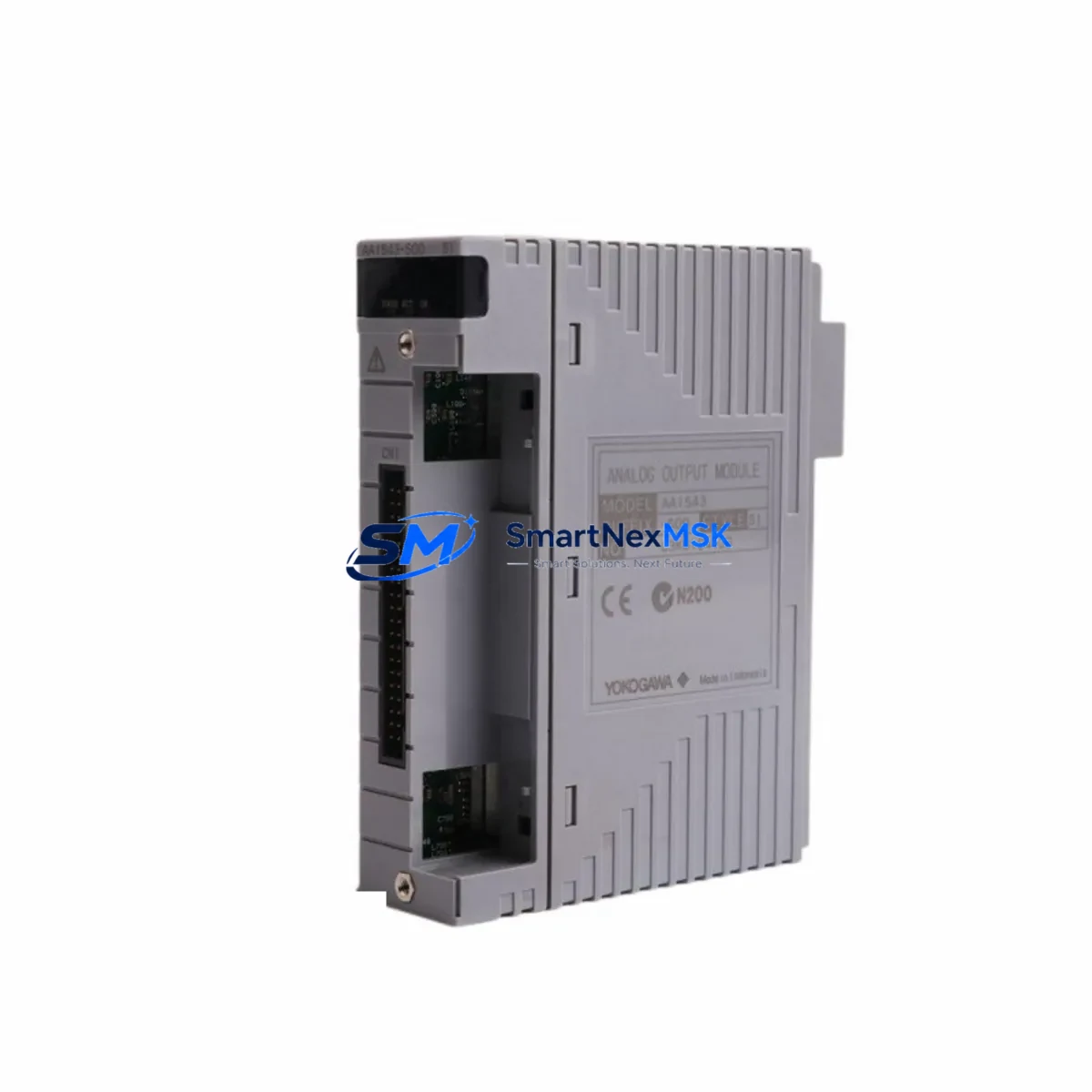
Yokogawa AAI143-S53 S1 Maintenance-Ready Spare for CENTUM Automation
The Yokogawa AAI143-S53 S1 is a 16-channel intrinsically safe analog input module designed for the CENTUM VP and CS 3000 distributed control systems. As a critical field interface component, this module handles 4–20 mA process signals from transmitters across hazardous and non-hazardous areas, making it one of the most frequently maintained items in any Yokogawa-based control cabinet. Sourced as an original Yokogawa spare, the AAI143-S53 S1 is tested prior to shipment, backed by a 12-month warranty, and available for immediate dispatch to minimize unplanned downtime in continuous process operations.
Maintenance engineers working on CENTUM VP or CS 3000 systems recognize the AAI143-S53 S1 as a high-priority spare. Its failure mode — loss of analog input channels — directly impacts process visibility, loop control, and safety interlock integrity. Keeping a verified replacement unit on the shelf is standard practice in petrochemical, power generation, pharmaceutical, and pulp-and-paper facilities where this platform is widely deployed.
Spare Maintenance Table
| Parameter | Specification |
|---|---|
| SKU / Part Number | AAI143-S53 S1 |
| Brand | Yokogawa Electric Corporation |
| Series Compatibility | CENTUM VP, CENTUM CS 3000 |
| Module Type | 16-Channel Intrinsically Safe Analog Input |
| Signal Range | 4–20 mA (IS barrier-isolated) |
| Channel Count | 16 channels per module |
| Installation | Hot-swap capable on CENTUM VP field control stations |
| Backplane Interface | CENTUM VP / CS 3000 standard node bus |
| Application Environment | Process industries: oil & gas, chemical, power, pharma |
| Hazardous Area Rating | Intrinsically Safe (IS) — suitable for Zone 1/Zone 2 |
| Origin | Japan (Original Yokogawa manufacture) |
| Condition | Original spare, pre-shipment tested |
| Warranty | 12 Months |
| Lead Time | In stock — ships within 1–3 business days |
| Maintenance Recommendation | Inspect channel calibration annually; replace on first sign of drift or channel fault alarm |
Maintenance Planning for Continuous Operation
When scheduling a replacement of the AAI143-S53 S1 during planned maintenance or emergency callout, experienced maintenance engineers treat the module swap as an opportunity to audit the surrounding electrical infrastructure. A single analog input module fault rarely occurs in isolation — it is often preceded or accompanied by degradation in adjacent components sharing the same field control station or marshalling cabinet.
Begin by verifying the field power supply feeding the IS barriers and the AAI143-S53 S1 backplane. Yokogawa field control stations typically use dedicated 24 VDC power modules such as the PW481 or PW482 series; confirm output voltage stability and check for ripple or thermal stress indicators before inserting the replacement module. A marginal power supply will shorten the service life of any new spare.
Next, inspect the ANB10D or ANB11D node bus adapter connecting the I/O module nest to the field control unit. Loose or corroded bus connectors are a common root cause of intermittent channel faults that are misdiagnosed as module failures. While the cabinet is open, check the terminal block assemblies (Yokogawa TB series or equivalent) for loose field wiring, corrosion on screw terminals, and correct torque on IS circuit connections.
For systems where the AAI143-S53 S1 interfaces with HART-enabled transmitters, verify that the HART communication path remains intact after module replacement. If the site uses a HART multiplexer or asset management system connected through the ALF111 FOUNDATION Fieldbus interface or a dedicated HART gateway, confirm device recognition after the swap. This is particularly important in facilities running Yokogawa’s Plant Resource Manager (PRM) for predictive maintenance.
Procurement engineers building a comprehensive spare parts list for a CENTUM VP or CS 3000 system should consider stocking the following alongside the AAI143-S53 S1: the AAI141-S03 or AAI841-S analog input variants for non-IS applications, the AAO145-S analog output module for paired control loops, the ADV151-P digital input module for discrete signal monitoring, and the ADA04-S or ADA06-S signal conditioner cards used in legacy CS 3000 marshalling panels. Maintaining a balanced spare inventory across input, output, and communication module types ensures that any single-point failure can be resolved within one maintenance shift without waiting for emergency procurement.
For sites with aging CENTUM CS 3000 infrastructure being extended rather than replaced, the AAI143-S53 S1 is a direct-fit solution that avoids costly engineering changes. Pairing it with a FCS (Field Control Station) CPU module spare and a set of ESB bus cables provides a complete recovery kit for the most common hardware failure scenarios in this platform generation.
Site Replacement Workflow
Replacing the AAI143-S53 S1 on a live CENTUM VP system follows a structured sequence to protect process continuity and personnel safety:
1. Pre-replacement verification: Confirm the replacement module’s SKU suffix (S53 S1) matches the installed unit exactly. The suffix encodes the IS specification and software compatibility level — substituting an incorrect suffix variant will result in configuration mismatch alarms and may require re-engineering of the I/O builder database.
2. Process handover: Coordinate with the control room operator to place affected loops in manual mode or activate the appropriate safety override. For IS-rated channels connected to safety instrumented systems, follow the site’s Management of Change (MOC) procedure before breaking any field wiring.
3. Module extraction: The AAI143-S53 S1 supports hot-swap on CENTUM VP field control stations. Unlock the module latch, slide the module out, and immediately insert the replacement. The field control station will automatically detect the new module and restore channel communication within seconds, provided the I/O builder configuration is already loaded.
4. Post-replacement validation: Verify all 16 channels return to healthy status in the CENTUM VP HIS (Human Interface Station) or the engineering workstation. Perform a loop check on at least two channels per module to confirm signal accuracy. Document the replacement in the site’s maintenance management system (CMMS) with the module serial number and installation date to support warranty tracking.
5. Legacy system compatibility: For CS 3000 installations, the replacement procedure is similar but requires manual re-download of the I/O module definition from the CS 3000 builder after insertion. Ensure the engineering workstation is connected and the project database is current before proceeding.
Spare Parts Support FAQ
Q1: Is the AAI143-S53 S1 compatible with both CENTUM VP and CS 3000 systems?
Yes. The AAI143-S53 S1 is designed for use in both CENTUM VP and CENTUM CS 3000 field control stations. However, always verify the exact suffix against your system’s I/O builder configuration before installation, as suffix variants encode IS specification and hardware revision details that must match the installed base.
Q2: What does the 12-month warranty cover, and how is it validated?
The 12-month warranty covers manufacturing defects and functional failures under normal operating conditions. Each unit undergoes pre-shipment functional testing. Warranty claims are supported by the serial number recorded at dispatch. The warranty period begins from the date of shipment and covers repair or replacement at our discretion.
Q3: Can this module be used as a direct drop-in replacement for a failed unit without re-engineering?
In most cases, yes — provided the replacement SKU suffix matches the installed module exactly and the CENTUM VP or CS 3000 I/O builder database already contains the correct module definition. No hardware re-engineering is required for a like-for-like swap. For CS 3000 systems, a database download to the field control station is required after insertion.
Q4: What is the recommended inventory strategy for this module in a large CENTUM VP installation?
For facilities with more than 10 AAI143-S53 S1 modules installed, industry practice recommends holding a minimum of 10% of the installed count as on-site spares, with at least one additional unit sourced from a reliable distributor on a standing order or consignment basis. Given the module’s role in IS analog input — a high-criticality function — a zero-spare posture is not advisable for continuous process operations.
© 2026 SMARTNEXMSK. All rights reserved.
Original Source: https://smartnexmsk.com
Contact: [email protected] | +86 18259474341